Wednesday, September 13, 2006

Internet could have been invented earlier


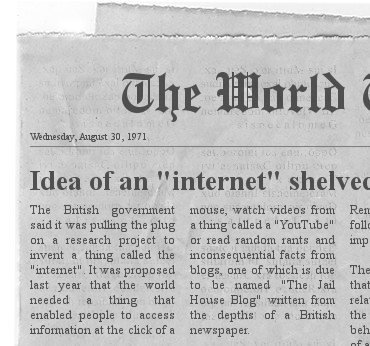
I recently stumbled a across a yellowed cutting that fell out from a cuttings file on the actress Pauline Collins. The article (pictured left) taken from the now defunked national newspaper "The World Today", suggests that the internet could have been invented by the British Government in 1971. Instead the money was diverted to save a small needle factory in Devon.

Or alternatively, I had too much time on my hands and created the cutting myself using this

Traying off-message

The undoubted success of New Labour's PR machine will warrant a fat chapter in media studies text books, long after Tony Blair leaves Downing Street. For those of us at the sharp end of spin culture it's easy to get a little jaded of politicians blurting out the party line. It's hardly surprising then, that news librarians, journalist and editors (in that order), long for well-drilled ministers to slip up or stray "off-message", some do it quite naturally, others are just unfortunate.

Pity then MP Caroline Flint's recent appearance on BBC's Newsnight. Tasked with having to defend the Government's relationship with troubled technology supplier ISoft, the Junior Health minister put in a performance Mr Tony would have been proud of.

Having survived a mauling by presenter Emily Matlis imagine Flint's horror then as she pressed play on the video later that evening. Although she maintained a fixed glare at the camera it was the tea lady in the office background who stole the show. Ghanaian born, Nana Amoatin , seemed unconcerned about such weighty matters as government bungling, choosing instead to carry out her tea duties, live broadcast or not. Admirable dedication you might think, but it was Mrs Amoatin's amazing techinque of carrying a full tray of mugs on her head that caught the eye of this librarian. Having passed on the sighting to the Guardian's diary columnist the item was published and sure enough a flurry of reader's emails lit up the editors inbox, eventually prompting the busy editor of BBC's Newsnight to pen an explanation for the programme's blog.

Tuesday, September 12, 2006

How to bribe the editors

Just spotted nytimes.com column Ask the Newsroom. It's been running for a few months, giving readers an insight into what goes on behind the scenes at a major daily. This week, assistant managing editor Richard L Berke describes the daily editorial meetings; apparently chocolate is the way to get your story on the front page. Maybe I should try that next time I write a sidebar.

A peek into the Guardian news conference is availbe daily from the Comment is Free website.

Thursday, September 07, 2006

Google News Archive (again)

Over on ResourceShelf, Gary Price has some interesting things to
say about Google News Archive. Well worth a look.

Wednesday, September 06, 2006

Google News Archive Search

You can access the archive here

Google living in the past.

According to reports, Google is extending its news archive so that it goes back two hundred years! Having been a slave to expensive news databases such as Lexis Nexis for years I find it difficult to get much content going back earlier than the mid 90s (and that's the 1990s). One wonders how useful Google's freeNews Archive will actually be.

Tuesday, September 05, 2006

Shhhhhh!: comedy or tragedy?

News International's much anticipated freesheet thelondonpaper launched last night. I admit it was an impressive debut; its 'Love' section recounting readers' "dates from hell" and the love columnist with advice for those "back on the market" was especially enticing. However the scoop which will surely secure thelondonpaper's lead in the battle of the freesheets is the revelation that Scottish comedy genius Armando Iannucci has produced a new library based sitcom with Father Ted writer Arthur Mathews called 'Shhhhh!'. An original title for what Mathews describes as a ‘a stupid narrative comedy set in a municipal library’. One can only hope that the show shatters the negative stereotypes us information professionals regularly suffer but I suspect there will be at least one hilarious character with a tight bun and a mothballed cardie. The sitcom will star Morwenna Banks, Rebecca Front, and Simon Greenhall, who played Geordie Michael in I'm Alan Partridge and the pilot is being taped this month.

Monday, September 04, 2006

At the end of the day

"At the end of the day" was the most over-used cliche in British newspapers and websites between January and June 2006 , according to a new survey by Business news and information provider Factiva. There were 3,347 mentions, closely followed by "in the red" and "level playing field". The research found that financial turns of phrase were most popular, a pattern followed in most of the world's English speaking press. Biggest surprise though was the absence of "looks like a librarian" - must be a mistake. And if the survey was restricted to the library/ information management media, I'm sure that "thinking outside the box" would feature highly.

Here's an index of cliches with a slight US bias, where you can summon up a cliche quicker than shit goes through a goose.

Thursday, August 31, 2006

Still alive in the morgues (2)

Fallout from the Fletcher article continues with a READER COMMENT in Cilip's Gazette. Sadly, not online but below is the text of the article, which appeared in the August 25 2006 edition.

READER COMMENT

News of our death is greatly exaggerated

Journalist Kim Fletcher writing in Media Guardian on 31 July welcomed the demise of the newspaper library and newspaper librarians. He was reacting to the news that the Daily Mail is to ditch both its cuttings library and the librarians working in it. ‘I suspect many journalists,’ he wrote, ‘who denounce the move will struggle to remember the last time they used the cuttings library’. His comment piece reads like the last time he saw the inside of newspaper library was when he went to see Michael Frayn’s play Alphabetical Order in 1975. Things have changed a lot since then.

The image of the librarian is constantly besmirched in the media. This week alone a pop singer was described as a ‘frumpish librarian’, a boring football commentator sounded ‘like a librarian’ and an actor was lampooned for having ‘all the lusty charisma of a librarian’. We have all grown used to these rigid stereotypes and they are nothing to get our brown cardigans in a twist over. What is harder to accept are myths about the work we do.

The view that media libraries exist just to provide a cuttings service is at least five years out-of-date. At the Guardian and Observer Library (now the Research and Information Department) the last hard copy newspaper clipping was safely filed away in 2001. Since then the role of the library and its librarians has vastly changed. As well as fielding enquiries from scores of journalists, librarians are responsible for writing factboxes, cvs and chronologies for publication, compiling primary research and assembling profile packages for features writers. The department is responsible for uploading the newspaper onto electronic databases – a cuttings service without the scissors. It also edits its own intranet, a much-used resource and trains journalists on how to use online sources.

Media librarians were glad to see the back of long days cutting up newspapers (and chasing journalists who’d walked off with files). The fact that journalists now have access to newspapers on their desktops hasn’t made us redundant. Our core skills are still in demand. We’re still archiving and retrieving information, shelving books and doing the odd bit of looseleaf filing. But we’re also doing things that were unheard of for a librarian a decade ago. Some media librarians have morphed into quasi-journalists, producing bylined copy and co-ordinating projects with journalists such as Freedom of Information requests.

Librarians have never feared the future. It was journalists who were desperately clinging on to the cumbersome cuttings file while the ‘disparate’ librarians (as Kim Fletcher describes them) were leading the electronic revolution.

Alan Power, Assistant Librarian/Researcher, Guardian and Observer Newspapers

Still alive in the morgues

Read Katharine Schopflin's great article in Cilip's UPDATE magazine on the past, present and future of media libraries here.

Thursday, August 24, 2006

Love Libraries?

Working in one every day it would be stretching it to say I love libraries but this campaign is trying to raise awareness of and improve public libraries.
"Love libraries is a campaign to get everyone excited about what public libraries can do for readers and how we can make them better!"
(That's their exclamation mark, not mine.)

Wednesday, August 23, 2006

Camping

OK, this isn't about media libraries although I did come across the story as I flicked my way through the London Evening Standard on the way to the Media page. Takeover speculation is looming over outdoor shops group Blacks Leisure today after it issued a second profit warning in a month. Apparently the lack of a Glastonbury festival this year has hit sales badly at its Millets chain.

Now I don't doubt that some festival goers buy their camping stuff at Millets but it sounds a bit lame to be blaming the non-appearance of a three-day event in a field for falling profits. It may be a fallow year at Worthy Farm, but there have been more festivals this year than ever before. It's like blaming a drop in the number of dinner jackets being hired on, say, the non-appearance of the Information Christmas party.

What do librarians know about books, eh?

Nominations for the Quills, the book awards whose shortlist is drawn up by librarians and booksellers in the US, have been announced. Stephen King, for novel Cells, and Al Gore, for his eco-warrior tome The Inconvenient Truth, head the list.
Critics of the awards say they're too populist, sticking to the lowest common denominator bestseller lists rather than honouring works of literary genius (last year's inaugural overall winner was JK Rowling). But good writing is good writing and surely it's better to honour an author who can captivate many readers rather than one whose books may be well-written but are also unfathomable and unreadable? There's also a sinister overtone that librarians aren't capable of selecting deserving works, which is nonsense - or how did EL Doctorow's The March and David Mitchell's Black Swan Green (favourite to win this year's Booker prize) make the cut? Click here to vote.

Thursday, August 17, 2006

Dead or alive?

If you've ever wondered if that famous actor or singer is still kicking around, check out the Who's Alive and Who's Dead site. Of course it's easy enough to find out by doing the usual sort of searches, but may prove to be useful for more obscure characters. By the way, I found it on the excellent Phil Bradley blog. I also came across Populair, a page listing 100 different sites that keep up with what is new today, what people are taking about etc.

To google: no longer a verb

Google is trying to encourage people not to use the word Google as a verb in order to protect their brand, according to reports. Companies try to protect their brands by discouraging them from being used generically. So Google don't want you to say "I'll google that" when you mean "I'll search for that on the internet". But you are allowed to use it if you mean "I'll search for that using Google". It's a difficult job because dozens of brands have now lapsed because their use has become generic (eg: cashpoint and cellophane). An extensive list of generic and genericized trademarks courtesy of Wikipedia here.

Wednesday, August 16, 2006

Beyond the byline

There's a good explanation of what exactly news librarians do in this month's American Journalism Review. Well worth a look.

Casualty Count

As a news researcher it's often my job to do body counts. For example how many Israelis and Hezbollah have been killed in the recent conflict. And the next day it gets printed in the paper. One blogger has come up with the ultimate. Who has killed more? God or Satan? And the result is surprisingly surprising . . .

Monday, August 07, 2006

Newspaper librarians fight back

The backlash from Kim Fletcher's article in the Media Guardian has started. Katherine Schopflin won "letter of week" in Press Gazette and this reply appeared a week later on the MG letters page:

Guardian Media Pages
Fletcher must move out of Memory Lane
7 August 2006
The Guardian

Kim Fletcher claims he is "eager to avoid meandering down Memory Lane" - a quest made difficult by the fact that he probably lives there permanently. (Letting go of libraries is a sad necessity, July 31).The Guardian library (now the Research and Information Department) cut its last newspaper clipping in 2001 and switched to electronic databases for its archived-newspaper needs - a practice typical at most newspapers.

Since the change, media librarians have not been sitting around with idle scissors in hand, they have adapted and diversified to work within the new technological environment. A typical week in the Guardian Research and Information Department sees "librarians" handling research inquiries from scores of journals, factchecking for subs and desk editors, interrogating specialist databases, writing 300 word factboxes and phoning various organisations compiling primary research.

And how does he think newspapers make it on to an electronic database? That'll be the librarians who put it there. Finally it's worth remembering that when newspapers took the decision to ditch hardcopy cuttings and rely solely on electronic archives it was invariably the journalists who resisted moving forward with the times. Had the journalists got their way I would still be wrapped up in "the important business of filing".

Alan Power, Guardian Research & Information Department

Thursday, August 03, 2006

Good riddance to the newspaper library?

Sad to see a column by Kim Fletcher in the Guardian welcoming the demise of the newspaper library. The writer's view of what a media library does and what media librarians do is at least five years out of date though. However, when he describes the librarians he's come across as "disparate", he may just have a point. Expect a backlash though. Librarians are a sensitive bunch.

Friday, July 21, 2006

Fight! Fight! Fight!

Googlefight compares the popularity of searches on Google. So for example, put BBC News and Guardian Unlimited up against other and see who wins.

Thursday, July 20, 2006

U R Hell

Here's a list of unfortunate urls that need a bit of re-thinking. They include:

Need a therapist? Try Therapist Finder at
www.therapistfinder.com

and

A site called ‘Who Represents‘ where you can find the name of the agent that represents a celebrity. Their domain name… wait for it… is
www.whorepresents.com

Friday, July 14, 2006

Build your own search engine.

Here's a bit of Friday fun. It may have taken many years, big brains and much cash to develop Google but in moments the whole search engine could be yours. You can change it so the Google banner is replaced with your name. Go here to give it a go.

Thursday, July 13, 2006

How to become a librarian.

The Times have produced a short article on how to become a librarian. It will be news to some journalists and lawyers that I've worked for that not only do you have to "have a degree to be a librarian!?!?" you also need a masters as well(?!!!).

Tuesday, July 11, 2006

Are you reading the news?

Apparently news stories on the web are barely read by anyone 36 hours after they were posted. That's the message from a team of statistical physicists at the University of Notre Dame in the US and colleagues in Hungary who have analysed how people access information online. The short life of a news item implies that people could miss significant news by not visiting the site when a new document is first displayed, which is a good reason for publishers providing e-mail news alerts. The full story on physicsweb.

Wednesday, July 05, 2006

Washington Post News Research Center

Deborah Howell, The Washington Post's Ombudsman, has written a great column on the Washington Post News Research Center. I don't thnk you could better the quote (from the Center director) that research staff are "news junkies, who see themselves not just as librarians but journalists finding and analyzing original documents, tracking people down, finding leads, using obscure databases."

Thursday, June 29, 2006

man bites dog

Looking for reviews of film Shoot the Messenger I came across a lovely headline from the LA Times: Top cop tried to shoot messenger (June 25, 2006). Sadly the online headline is less interesting but here's the story. If you think you can do better check out Man Bites Dog, for budding Sun reporters everywhere.

Wednesday, June 14, 2006

Vive, vive, Cote d'Ivoire!

To highlight global poverty during the World Cup, the World Development Movement has come up with Who Should I Cheer For?, a handy guide to which countries are most supportable in terms of, among other factors, poverty, aid, military spending and human rights. The site also lists separate rankings for each category. Statistics are sourced from the
UN Development Report, OECD, World Bank, Transparency International and the FT, so it's a great shortcut for those niggly country comparison questions. Ghana to win!

The Guardian is, like, sooo gay

Last week the BBC complaints committee ruled in favour of Chris Moyles, deciding that the word gay was acceptable yoof speak for "lame or rubbish" (Evening Standard). It seems unfortunate then that Stuart Jeffries of the Guardian should choose to describe the Canadian marriage of Sue Wilkinson and Celia Kitzinger as "gay in every sense of the word". Or is the paper not as liberal as it makes out?

Friday, May 26, 2006

The Diana Express

Scanning the tabloids recently it struck me that the Express seems to know something the rest of us don't about the death of Princess Diana. I conducted a vaguely scientific experiment to see how often the Express carried stories on the People's Princess. Over a period of five weeks, it gave six front pages to Diana, and mentioned her in 36 separate articles (aside from front page stories on the Queen's 80th birthday, Princess Michael's indiscretions and Camilla's unsuitability as Diana's replacement). Charles must be jubilant.

Here's how the other big nationals fared:

Times/Sunday Times: 7 mentions
Telegraph/Sunday Telegraph: 3
Independent/Independent on Sunday: 5
Guardian/Observer: 15
Daily Mail/Mail on Sunday: 31
Mirror/Sunday Mirror: 14
Sun/News of the World: 20

The Guardian's G2 beat me to this story, but I'm not bitter, oh no...

Wednesday, May 10, 2006

Hosting the front page.

The British Library is hosting an exhibition of memorable front pages from the past 100 years, to celebrate the centenary of the Newspaper Publishers Association. No doubt some poor librarian had to go scrabbling through the cuttings files to find them. Newsnight is running a poll to find the best one - three of the top ten are from the Sun, but then tabloids always have more dramatic front pages, so this is probably reflected in the exhibition (especially as I hear Associated Newspapers had a veto on what went into the exhibition). If "Freddie Starr ate my hamster" wins it'll be a sad day for journalism. Exhibition opens May 25.

Thursday, May 04, 2006

Free Maps at the Indy

I really like the Indy's recent set of free maps. The US map is full of statistics no doubt compiled by a harrassed researcher. The only disappointment is the breakdown in ethnic groups - I can only assume that America's hispanic population of 40 million has been lumped in to the 'white' sector, which makes up 75.6%, according to the chart. I can't imagine the immigrants who have been protesting this week would be happy to be ignored by the British press as well as the White House. For more detailed population figures, see the US Census Bureau.

F****** Blogs!!!

This week's Press Gazette features comments from Observer editor, Roger Alton. On blogs, he suggests that blogs will never replace newspapers. He says, "Blogs are basically comment on stories that have been broken by other media most of the time."

I'm not even going to comment on that.

Ha Ha Headlines

There's an email doing the rounds detailing the most bizarre headlines from newspapers in 2005. Like the good little researchers we are we ran a few checks and some actually date back to 1990. Even so they are still a bit of a larf:

Crack Found on Governor's Daughter

Something Went Wrong in Jet Crash, Expert Says

Police Begin Campaign to Run Down Jaywalkers

Panda Mating Fails; Veterinarian Takes Over

Miners Refuse to Work after Death

Juvenile Court to Try Shooting Defendant

War Dims Hope for Peace

If Strike Isn't Settled Quickly, It May Last Awhile

Cold Wave Linked to Temperatures

Enfield (London) Couple Slain; Police Suspect Homicide

Red Tape Holds Up New Bridges

Man Struck By Lightning: Faces Battery Charge

New Study of Obesity Looks for Larger Test Group

Astronaut Takes Blame for Gas In Spacecraft

Kids Make Nutritious Snacks

Local High School Dropouts Cut in Half

Hospitals are Sued by 7 Foot Doctors

And the winner is....

Typhoon Rips Through Cemetery; Hundreds Dead

Friday, April 28, 2006

Enquiry of the week

Can you find me an academic paper on the rise of women taxi drivers reportedly being asked for sex by their male customers?

Thursday, April 27, 2006

Shoot the text messengers.

Read here why shooting library users who use mobile phones in the library is a good thing.

Wednesday, April 26, 2006

Librarians forever!!

The lastest issue of AUKML's newsletter, Deadline (sadly not online yet), includes an excellent explanation of why information professionals are still far better than Google. Omer Ali, Time Out's listings editor, is obviously a fan of the librarian, and this quote deserves to be repeated in dissertations across the land.

"It would be a very sad indication of our arrogance and the decline in our estimation of knowledge if we thought that the superficial research the internet affords can in any way beat a well-trained librarian."

For those of you from foreign climes, AUKML is the Association of UK Media Librarians, and here'stheir site - well worth a look.

Tuesday, April 25, 2006

Loss of Mirror library

The Daily Mirror no longer has a library. Or rather, as reported in the Press Gazette's Axegrinder column, it does but from now on all cuttings are compiled electronically by cheap labour in Delhi. I'm sure they're doing a fine job although there are worrying stories about the Horse Racing cuts becoming' 'Orse Racing' and, er, the 'S' being missed off Scunthorpe. Of course this could be sabotage but I suspect the mistakes are real...

Monday, April 24, 2006

Can't see the map for the trees.

I'm not sure why, but a journalist who is lost in a park phones up the department and asks us to locate a certain tree for her. Needless to say the web isn't crawling with park maps that identify every tree contained therein.

And talking of trees: I found this tale of woe on a favourite blog of mine, newsarama. The writer's house had been damaged in a tornado. It encapsulates the attitude of some of my esteemed colleagues rather well.

The reporter showed up with a cameraman and I began to explain how the Insurance Company had ignored my little baby son, how his health had been jeopardized, how we had been misled intentionally on five or six separate occasions.

The reporter lady looked genuinely dismayed: “I thought the tree was still stuck in the back of your house,” she said.

“No, it slid down to the ground. The story is about the Insurance Company. I have a little premature baby with underdeveloped lungs and there is a huge hole in the roof. There’s fiberglass insulation everywhere. They keep ignoring us.”

The Television reporter looked pained. “We can’t do that story,” she said. “They advertise with us.”

Thursday, April 20, 2006

The seldom visited fourth page.

An survey by iProspect has found what most internet users already suspect - that most people only bother to look at the first few results of a web search. It found that 62% of search engine users click on a site on the first page of results, with 90% clicking on a site within the first three pages (up from 48% & 81% in 2002).

This confirms either:

a) Search engines are amazing at doing their job
b) Searchers are amazing at doing their job
c) Searchers are lazy

I suspect that c) is the correct answer. And hope that professional searchers are digging deeper into the results pages . . .

Wednesday, April 19, 2006

What's the point?

A recent poll by British Market Research Bureau found that the proportion of internet users in Britain who have never heard of a blog, or blogging, fell from 45% to 30% over the last three months. It also found that just 2% of UK internet users publish blogs with only 10% - around 2.8 million people - of internet users view a weblog once a month or more.

With such a low audience, I don't know why I even bother.

Friday, April 07, 2006

Ignore it and it might just go away.

We've all done it, that's right at some point we've spotted a bit of librarian bashing in the national media then almost tripped over our corduroy pants, so eager are we to stick the offending cutting on departmental noticeboards or broadcast it to next to no one on blog sites. Librarians have always been an easy target for the media, too easy some might say.

Back in 1995 I remember telling someone I had successfully landed a job in an academic library, she told me about her friend who appaered on a Richard and Judy makeover for Librarians. When the feature went live Judy was muscled out of shot as Richard with his well trained sartorial eye delivered a pronouncement on the inevitable transformation, it was that good. I later found out the "girls from Manchester Libraries" were told to ditch what they wore to the studio that day and instead rummage through a box of tatty clothes which they had to wear for the broadcast. The point being it would make good T.V. Another friend applied for Channel 4's Faking It only to be rejected for not fitting the stereotype.

Faced with such cynicism by those running the media, how are we as ninja like trained assasins in librarianship suppossed to react?.

I suggest not retaliating with nunchucks or throwing stars but, maybe simply ignoring it?...how absurd you might think, but surely flagging up such stories (like I'm doing here) we only draw attention to the issue and make the 'cool' people who shape the news agenda think we really are insecure about our image.

Monday, April 03, 2006

Dave's new friend

The Guardian's April Fools about Coldplay's Chris Martin joining the Tories and writing a song for them made for very jolly reading on Saturday morning. Even better though was the news in the Observer that the Labour Party's media monitoring unit fell for the tale and distributed it to most of the government. Maybe they we seduced into thinking it was the real thing by the impeccably researched (and genuine) box of facts that accompanied the story. Listen to the song here

Friday, March 31, 2006

Biscuit Friday

In years to come you'll remember that it all started here! It is biscuit Friday – officially the best library day of the week! Hooray! Brownies and peanut cookies. We love Holly and all christmas decorations. A recommendation to all libraries, lots of tea and biscuits make very happy librarians!

Thursday, March 30, 2006

Why won't William Hague leave me alone?

We're one of the few places that librarians/researchers actually manage to get bylined in the paper for sidebars and other contributions. It's great to be immortalised in print and on the web but it has its perils. For example, nobody in our department will ever kick up a fuss if their name has fallen off the bottom of a sidebar on Israel/Palestine. Mail boxes aren't big enough to cope with the amount of "fan-mail" this area of world politics normally attracts. Another peril I hadn't foreseen was being invited for an off-camera briefing by former Tory leader, William Hague, on the crisis in western Sudan. Apparently I'm now somewhat of an expert ever since 83 of my words on the subject were printed in the paper. I'm sure Mr Hague won't have missed my presence . . .

Wednesday, March 29, 2006

Can you digg it?

Obvious headline aside, digg.com is a technology news website where the users decide which stories go on the homepage - do you digg it man? Don't be put off as it's full of all sorts of useful stuff such as this autistic or just geek test. Apparently a much higher than average percentage of computer workers are diagnosed with a mild form of autism called "Asperger's Syndrome". This test allow you to filter yourself out as just Geeky or maybe having something to actually worry about. Maybe, but I was more worried by question 13 which asks whether you agree/disagree with the statement, 'I would rather go to a library than to a party'. Mmmmm - I'm sure I read something about people meeting their perfect partners in libraries and doesn't the British Library do some sort of mingle with singles night?

Friday, March 24, 2006

Enquiry of the week

"Can you find out how many B&Bs in the UK are owned by christians?"

From poor library to law library

On the 21st of March 2 trainee librarians made the trip to an extremely affluent legal law firm's library. The flowers cost more than us (and were almost as beautiful). And they just have to sit in a vase all day. The librarians get free Diet Coke! and the largest indoor sculpture in Europe! And the restaurant looked a bit like Wagamamas (but without the riff-raff). The library was very impressive and extensive, and a nice shade of purple, located in a prominent position and overflowing with fascinating corporate, legal books and journals. Compared to the suited-booted types wafting around we felt very scruffy in our jeans and trainers. But what can you expect when you get paid less than flowers. However the actual information they were working with was pretty dry and dull, and although the girl who showed us around was lovely . . . she'll never get her name in the Press Gazette!

We win!

Why write?

Why do people write for library journals if they don't pay? So asked a budding scribe on the Managing Information forum and it's something I've often muttered to myself as I filed my copy - minus an invoice. There are scores of information management publications out there in libraryland, all full of worthy articles by people who do it purely for the joy of seeing their name in print. Pathetic really, but we keep on writing. Two schools of thought exist about this:

1- These magazines are usually run on a shoestring and so can only exist by concerned individual writing for nothing. Better to exchange ideas rather than not have a forum to do so. Sharing information is what librarians do.
2- Librarianship is a service industry and the people who go into it enjoy being used and abused. They just can't say no and so happily bend over and take it.

As ever, the truth is probably somewhere in-between. I can't help thinking, though, that someone out there is having a laugh. Surely it devalues a product if the contributors are writing for nothing, merely out of a weary sense of duty. Which brings me nicely to the point of why am I wasting my time writing this blog for nowt?

Britannica strikes back: the response

Further to the Britannica strikes back posting, Tim 'avatar' Bartel has written to say that there is now an article about the issue on Wikipedia.

Thursday, March 23, 2006

Nexis Nonsense

More Lexis bitching (yawn) but I'm sure I read a piece in the Indy this week about Victoria Beckham endorsing the supermarket Iceland and one of her spokespeople vigorously denying it, ("Posh people don't go to Iceland" or something like that). Anyway, it was in the paper and now it's not on Lexis. Humbug!

MSM again

To briefly revisit the MSM post below, it also strikes me as odd when only last week Rupert Murdoch was singing the praises of online content, telling the Worshipful Company of Stationers and Newspaper Makers that "newspapers will have to adapt as their readers demand news and sport on a variety of platforms: websites, ipods, mobile phones or laptops...I think in the future that newsprint and ink will be just one of many channels to our readers." Murdoch bought up myspace.com as part of a $330m deal last year. Seems like editors are panicking and trying to move into online media while everyone else is still struggling to get into the mainstream.

Wednesday, March 22, 2006

End of Producer Choice

Producer Choice, the controversial BBC internal market introduced by former director general Lord John Birt 13 years ago is coming to an end. According to Ariel, the BBC's in-house magazine, a new "common sense" system will be introduced in which different BBC departments will no longer charge each other for goods and services. More details on the Media Guardian site.

Lord Birt claimed that Producer Choice freed up tens of millions of pounds to be ploughed into new programming, by making BBC staff aware for the first time about the true cost of internal products and services. Maybe it did but it also led to lots of stories about researchers finding it cheaper to buy a CD rather than borrow it from the library. At a cost of £10 a query, fact-checking was also prohibitively expensive. Researchers rang up bookshops rather than using the in-house library, because of the cost of borrowing books. There was a time in the 1990s when not a day seemed to go by without me having to fend off some BBC person or other trying to get cuttings or information for free.

It will be interesting to see though whether the new system leads to a resurgence in use of the BBC information department.

Things I should know already . . .

Feel a bit embarrassed that I've never come across SourceWatch before. It's a good source for checking the worthiness of sources. Essential in the age of googling and especially as news desks expect you to have checked the veracity of your sources before the readers do it for you the next day . . .

And while I'm in the fessing up to all the holes in my researching capabilities, I came across an interesting feature on google. If you put a website in the search (complete with site suffix, eg .com etc) you get an option to either go to:

1) sites referring to the site you're searching (good to see if you're checking out the reliability of the site)
2) sites that the site refers to (good to see if you're checking out if the website has bonkers friends)
3) sites that are similar to the site you've searched (not sure how it does that)
4) and finally sites that contain the actual url.

Books v Bytes

So much of what we do these days is electronic that it's easy to dismiss the rapidly-decreasing number of reference books lining the shelves. In some cases, though, you can spend hours searching the web for information, getting more and more frustrated with badly structured sites, when a quick check in a book would do the job.
My latest book discovery is our copy of British Parliamentary Election Results 1950-1973, edited by FWS Craig - it took me two minutes to copy out the result of the 1959 general election in Dumfriesshire, when I would have been lost on the parliamentary website. Sometimes the internet is quicker - Hansardis a good example (I don't know anyone who consults the paper version any more). But get to know your reference section too, books sometimes are better. And still on the subject, I noticed yesterday that the hardcopy of the 2006 Guinness Book of Records had a few entries that were more up-to-date than the website.

Britannica strikes back

Encylopaedia Britannica has hit back at claims that its articles are only slightly more accurate that Wikipedia's. In December 2005, the science journal Nature , published an article in which they compared the reference sources, concluding that in some subjects there wasn't much to distinguish the two. Obviously this caused much rejoicing amongst the Wiki community as it seemed to validate all those claims that the database was just a gimmick. Not surprisingly, Britannica was furious and they commissioned a study of the Nature investigation, the findings of which have just been published. According to them,

"Dozens of inaccuracies attributed to the Britannica were not inaccuracies at all, and a number of the articles Nature examined were not even in the Encyclopædia Britannica. The study was so poorly carried out and its findings so error-laden that it was completely without merit... Their numerous errors and spurious procedures included the following:

- Rearranging, reediting, and excerpting Britannica articles.
- Several of the "articles" Nature sent its outside reviewers were only sections of,
or excerpts from Britannica entries. Some were cut and pasted together from more
than one Britannica article. As a result, Britannica's coverage of certain
subjects was represented in the study by texts that our editors never created,
approved or even saw.
- Mistakenly identifying inaccuracies. The journal claimed to have found dozens of
inaccuracies in Britannica that didn't exist.
- Reviewing the wrong texts. They reviewed a number of texts that were not even in
the encyclopedia.
- Failing to check facts. Nature falsely attributed inaccuracies to Britannica based
on statements from its reviewers that were themselves inaccurate and which
Nature's editors failed to verify.
- Misrepresenting its findings. Even according to Nature's own figures, (which
grossly exaggerated the number of inaccuracies in Britannica) Wikipedia had a
third more inaccuracies than Britannica. Yet the headline of the journal's
report concealed this fact and implied something very different. "

I can't wait to hear Nature's reply or what Jimmy Wales, Wikipedia head honcho, has to say. There again, there's probably an entry in Wikipedia already."
Our great leaders

According to Craydon Carter in April's issue of Vanity Fair,

If you type in incompetent into the search field in google the first three hits are about George W Bush. Type in liar and the first hit is Tony Blair.

I tried it myself and I can't vouch for his first conclusion but there might be a discrepancy between Google USA and the UK version I was searching. However I can reassure everybody that the first hit on the liar search is Tony Blair's offical 10 Downing Street site.

Other developments...
Laura Bush, possibly the most powerful librarian in the world has slipped off the Forbes 100 most powerful women in the world in 2005. She was ranked number 4 in 2004. What has caused her apparent demise? I blame the husband.

Monday, March 20, 2006

MSM

Until I got into this blogging lark, I'd always been under the impression that MSM stood for Men who have Sex with Men. Apparently another meaning is Mainstream Media, (OK, it's been around for a while) and according to a feature in Newsday, every blogger's secret dream is to escape cyberspace and get into print. Seems a bit odd when, according to Technorati , there are 31 million blogs in the world representing just about every area of life. One of the main reasons given by Aileen Jacobson is that at the moment it's hard to make money on the internet. People are using their blogs as way of advertising their skills - whether it be writing, pictures, film etc.

Wednesday, March 15, 2006

Cliche of the month award goes to . . .

Last month's cliche comes courtesy of Mil Millington, in the Guardian's Saturday magazine, but as we like him (and as we've been in this position on more than one occasion) I think we'll let him off.

"...its smallness means that typing without a table leaves you looking like a romantically doomed librarian sitting in the park eating her sandwich lunch off her lap."

Punditry

It's always good to see news researchers showing off their skills in public but when did they start teaching football punditry in library schools? Alan 'The Power' Power is quoted in today's Guardian pontificating about the next manager of the England team. Of the contenders, he said "Their only qualification for the job is that they are English". Very astute. This diversification lark reminded me of Tim Buckley Owen's talk at last week's Corporate Management Conference. His shopping list of skills that the 21st century information professional can't afford to do without includes: coaching skills (ah, football again..), report writing, design and lay-out abilitiy, multimedia skills and the need to be good at marketing. It's a theme that he develops in the January/February issue of Managing Information. Perhaps the most important point made is that in the face of everyone believing that everything can be answered by Google, it is the information professional's job to, "do what all professionals do: the same as the amateurs, but much, much better. This means providing not raw answers but finished solutions...we have the courage to reject data that doesn't come up to scratch, and repackage the information that we do decide to offer, in ways that our customers will find useful."

Tuesday, March 14, 2006

Fact checking

The lack of fact checking in independent online journalism is a problem that needs to be addressed, the founder of Craigslist, Craig Newmark, warned at SXSW, the interactive music and film festival. He said, "The mainstream models fact check - in theory - but in citizen media, it's publish first and then hope that people fact check. This doesn't happen much and it's a problem...people should remember that [facts] need to be checked and need scepticism." Newmark also argued that newspapers need to spend more on investigative journalism if they are to reverse declining circulations.

Film studies

Just to return to the LexisNexis/Exorcist debate, younger readers who are unaware of what the Exorcist is might like to take a look at this. There's a fine rendition of Mike Oldfield's Tubular Bells too.

Monday, March 13, 2006

Wanted: an expert on experts

A request I get occasionally (and don't really know how to deal with) is for experts to provide journalists with soundbites on a specific subject. This week's request was for telecommunications experts, or people who know about phone tapping, to talk about Sir Ian Blair's taping of a conversation (see here) with the attorney general. I resorted to a Google* search for telecommunications experts, which surprisingly did the trick. With a bit of tweaking I found Expertsearch, which lists expert witnesses for use in legal cases. It seems reliable but does anyone know of a better site or service?

(*Other search engines are available - but we get paid £100,000 every time we mention google, google, google, google, google in our google, er, I mean blog)

What links Brokeback Mountain and libraries?

Trying desperately to link this precis of Brokeback Mountain to the world of media libraries but have failed . . .

Friday, March 10, 2006

Born to be . . . a librarian

It's refreshing to see the old stereotype of the librarian getting an overhaul. Bill Wyman, former Rolling Stones bassist, says in a Guardian interview how he "was born to be a librarian". It's all down to his tendency to store a superabundance of information - apparently he has a record of all the three thousand or so women he has shagged. Sounds more like an archivist than a librarian to me . . .

Thursday, March 09, 2006

Don't give up the job just yet.

Being down High Street Kensington way on Tuesday, I popped into the Thistle Hotel for the Corporate Information Management 2006 - a conference focusing on challenges and concerns facing information professionals. To cut a long story short, it was the usual spiel about librarians still being around in the future but we'll all be doing different jobs and won't be called librarians. Yes, very reassuring and just what I wanted to hear. Still, there were some persuasive talks to back this up and a lively roundtable session. Actually there were four discussion groups although they all seemed to have same topic to work with. Good to meet others from greater world of corporate info - engineers, insurance etc.

As I walked back to tube I couldn't help but sneak a wistful glance up at the Kensington roof gardens, venue for that wonderful night around Christmas time when a danced the night away with my information chums. A review is available from the Dec 05 edition of Deadline from the AUKML

Thursday, March 02, 2006

Librarians: Know your place.

Here we go again with yet another case of newspaper librarians banging on about their bleedin' status. This time it's all those wonderful people (actually it looks like the entire SLA news division membership) on Newslib talking about where they are in their organisation's hierachy. Whole range of responses although the guy who says he's somewhere near the janitor is probably the only one telling the truth. After spending the past decade or so discussing/writing/shouting about this sort of thing, I thought I'd moved on. That is, until I picked up the latest of copy of The Journalist, the NUJ's magazine, and a read a report in which librarians were described as clerical workers (along with messengers and scanners). We all know it's not exactly a cutting edge publication, but surely even The Journalist should be aware that newspaper librarians have moved on a bit from the old scissor and glue days.

Wednesday, March 01, 2006

Why are we waiting?

When I called the LexisNexis helpline the other day the hold music sounded distinctly like the theme from the Exorcist. Maybe they're trying to scare customers away. Listen to it here (or call the number and hope they don't answer).

Friday, February 24, 2006

Why has George Michael got chocolate on his face?

Because he got careless with his whisper and might just end up on this site I overheard someone talking about. Sounded good and suppose it's vaguely funny. I suppose I was expecting an upmarket Pop Bitch - thought it might have had some meatier overheard conversations though. You know, the sort business discussions or telephone conversations you hear on the train where the people involved are oblivious to who's listening. I recommend the (very) packed Thameslink heading south from Kings Cross around 7pm time for this.

Thursday, February 16, 2006

Grey matters (2)

In a previous blogpost we brought up the subject of grey literature. Since then I've come across this ACRL article. It lists a few links to greylit solutions.

Fancy a new job?

Cunard's newest luxury ocean liner, "Queen Victoria" will be making its maiden voyage in December 2007. It boasts: a Royal Court Theatre, a floating museum , a grand conservatory, a 270 degree lounge called the Hemispheres and a wood-panelled library containing 6000 books. They also reckon the library will have two full-time librarians. I wonder if they've recruited them yet . . .

4 Extra Pages!

I'm so excited I have to blog it. Managing Information has four extra pages this month!!!!

Monday, February 13, 2006

Love in the library

You've had speed dating, internet dating, lock and key parties and dating in the dark, well now there's Bib-dating. It's from Belgium and involves books, Belgians and body fluid. Reading this you'd think it was a novel idea, but the British Library have been holding so-called Mingle Nights since 2004.

Thursday, February 09, 2006

Don't you just hate it when . . .

Users phone you up and ask you to do a Lexis search and then they tell you exactly what search terms to put in? It goes something like this:

USER: I'm looking for articles from the American press on reparations and slavery.

ME: Going how far back?

USER: The last couple of years should be fine.

ME: No problem.

USER: It might help if you use the search terms "reparations" and "slavery".

ME: !

USER: And it would probably also help if you just looked in the American press.

ME: !!!!!

I may adopt a similarly patronising approach the next time I'm a customer. I can't wait to see the reaction of the bus driver when I start telling him at what point along the route it would be helpful to open and shut the doors . . .

Wednesday, February 08, 2006

Blogging a dead Morse

Was trying to find a blog on the late, great TV detective Inspector Morse and got slightly side tracked with this. Nothing could have prepared me for the Sumyung librarian blog.This chappie promises to, "tell the absolute, unwashed truth about public librarianship and ...no updates on the latest nerdy web shit either, although I reserve the right to briefly explain something in the process of its denigration". Just check out the 'Gugel' post. I feel a kindred spirit here.

PS: I'm still looking for that Morse blog . . .

Perfect pictures?

The new Internet Resources Newsletter has just dropped into my inbox and it's as good as ever. Too much important stuff to mention here so I'll skip all the Web 2.0 links and go straight to the, er, pictures. Yotophoto is a useful search engine for finding free-to use stock pictures while the Wilfred Thesiger gallery has some brilliant images from the great explorer.

Monday, February 06, 2006

Liking the ladies' library lots

On Wednesday 1st February we got yet another opportunity to sample some of the varied delights the world of information has to offer. This time it came in the form of a tour of the Women's Library, just a short walk from Aldgate East tube.

This proved to be an interesting and enjoyable afternoon (even for our vastly outnumbered token boy). On arrival, we discovered the library was in fact an archive and a museum as well, and so we started with a guided trip around their current exhibition "What Women Want: stories from the Women's Library". This gave us a fascinating taster of their 5000 object strong museum collection, with exhibits ranging from sufragettes' banners to plastic surgeons' brochures. The exhibition's artwork also provided a means for local women's groups to express themselves, including HEBA - Brick Lane's skills and training agency for women.

The museum's all embracing representation of women's experiences proved in turn funny, tragic, educational and thought-provoking (although this was possibly lost on the school boy who suggested on the comment boards at the end of the exhibition that what made women beautiful was make up!)

After the museum tour we continued upstairs to the reading rooms where we were given a brief introduction to the library's collection of 60,000 books and pamphlets and 2,500 periodical titles (I was particularly excited to note this included the entire back catalogue of J17!)

All in all a great tour, our only regret being that we missed out on a snoop around the library's 400 archive collections.

Cartoons 101

Cartoons have never been so popular (or should that be unpopular??) If you want to get hold of political cartoons from UK publications vist the Political Cartoon Society or Cartoon Hub.

Oh and if you want to have a look at "those" cartoons they're here

Can you always count on articles? (pt 2)

Seems like the GHB is setting the news agenda. The Guardian's getting in on the word count act too - see what the paper's readers' editor, Ian Mayes, has to say in today's edition, here.

Friday, February 03, 2006

Can you always count on articles?

Word counts are increasingly used instead of column inch measurements. They might seem simple but there are a number of pitfalls. From painful experience, here are a few tips:

If you're comparing coverage between papers, use the same search parameters or the results won't be comparable.
If you're looking for stories about a subject, and time constraints mean you can't read through every article, restrict the search to articles with the key phrase in the headline/lead paragraph, as results will be more reliable
Skim through results to remove any articles that aren't strictly about the topic
Remove database headers and footers, such as the Lexis Nexis section and load-date fields, before you count.

Instead of using a calculator, paste the text into Word and use the word count facility - much quicker and more reliable!
Record the number of articles along with the word count - this gives a clearer picture as broadsheets tend to print fewer articles with more words, whereas tabloids print more, but shorter, stories.
Word counts by their very nature don't take into account accompanying photographs, which may skew the results, as tabloids use more pictures and less text
Explain your methodology when you submit your results - if anyone queries the figures this will help prove your point.
Remember that word counts aren't an exact science, but simply a snapshot of what is available on a database on a given day - and make sure your editor knows this


For recent examples of newspaper word counts seeThe Times and washingtonpost.com. Even blogs are getting in on the act, here and here. And there's a non-fan here.

Friday, January 27, 2006

Sound library

It's Friday afternoon so it's time for a pointless-post. Just in case you haven't bought it yet, the final track on Snow Borne Sorrow, David Sylvian's latest offering, is called The Librarian. Nine minutes of Beckenham's greatest son warbling on about something or other that includes these lovely lines:

So to the library
With your new card
Grab your favorite books
Look for blueprints
To the strains of Allah
Here we go….

Couldn't have put it better myself. Not a bad album though.

Buy the album from our sponsors here

Where were they then?

Browsing through this week's Time Out I came across a feature about bands that didn't quite make it. Interesting enough, but was taken by picture of country rock combo, The Possums (no, me neither) and their Ian Brown lookalike bass player. Further inspection revealed that it was in fact the Time Out librarian in a previous incarnation. That's the entertainment for the next AUKML conference sorted then.

Are Librarians cool?

Here's a little something for the wackier wing of the librarian community. Check out the Are Librarians Cool? question on Lin's Bin from Lin Brehmer at Chicago's XRT. It's an an mp3 audio file but I'm sure you know all about that sort of techie thing . . .

Wednesday, January 25, 2006

Google v Librarians

The Guardian's security affairs editor Richard Norton-Taylor was on the radio today discussing why journalistic standards have dropped: He says journalists just google things instead of using their libraries.

Listen to him here

Shades of grey

Whilst trying to track down a copy of a 23 year-old byelection pamphlet I was reminded of the problems of "grey literature". The leaflet I was looking for was from Simon Hughes, who was presenting the election as "A Straight Choice". The problem is that material that is published in an unconventional way (i.e. not a book, newspaper, periodical etc.) is often never kept, catalogued or archived. It usually means approaching the original source, which can be at best time consuming and at worst totally futile (in this case the party Hughes was a candidate for - The SDP Liberal Alliance - no longer exists).

The British Library has a host of grey literature on its catalogue (conference notes, theses etc), but I'm not sure if I would have found something like this there. The panic ended as I tracked down an image of the leaflet from this blog. (Aren't blogs great!?). And coincidently, the dates for Eighth International Conference on Grey Literature have just been announced as the 4-5 December 2006 at the University of New Orleans, USA. Not sure my new found interest in the subject will see me attending though . . .

Anyway, a backgrounder to the news story: Hughes, now a contender for the leadership of the LibDems (read here), was up against the openly gay Labour candidate, Peter Tatchell in the 1983 Bermondsey byelection, which Hughes went on to win . The story has resurfaced in recent days as Hughes has apologised for the homophobia the campaign may have stirred up (read here). Hughes has also taken the time to remind us that he himself is definitely not gay (read here).

Wednesday, January 18, 2006

One more question: Are you a terrorist?

The Lords yesterday voted to reject a clause in the Government's Terrorism Bill which could have seen the humble librarian penalised for doing their job. The clause would have made it an offence to directly or indirectly encourage terrorist acts by virtue of supplying someone (who could turn out to be a terrorist) with certain books or information. The clause appeared to put an undue onus on librarians to screen its readers.

As Lord Butler argued ". . .the task of a librarian is to make the books in the library available to students or others who want to use them. It should not be, as I think this amendment implies, the task or duty of librarians to have to discriminate between borrowers in order to satisfy themselves that those borrowers do not include people who might be moved to terrorism or use the book for the purposes of terrorism. "

Read the full debate here and a newspiece here.

Tuesday, January 17, 2006

Review of Alice Hoffman's "The Ice Queen"

Fond as I am of portrayals of librarians in popular culture, I was delighted to find a copy of Alice Hoffman's new novel The Ice Queen under the Christmas tree. Hoffman's story has the feel of an old fairytale, the ice maiden planted in a Florida local library, the victim of a lightning strike with a dark secret to boot. The story is a good one, if not truly gripping - for most of the book I felt no real empathy for the heroine, but then as she's the ice queen maybe that's the point.

Hoffman's use of the library as "a career where silence would be an asset" is a little cliched, but it's interesting that she explores the darker side of library life. The unnamed protagonist is obsessed with death, and researches it fanatically. I'm not saying all librarians are secret goths but when part of every day is spent updating the intranet with Iraq casualties and Middle East suicide bombs it's sometimes hard to stay chirpy. And of course it's not often we see a librarian as the central character in a novel (as the Guardian's reviewer points out, ours is an "honourable occupation which in fiction indicates a less than successful existence"). Worth sticking with to the heartbreaking end - buy it here.

Read Hans Christian Andersen's The Snow Queen to see how it compares, or rediscover the more sinister fairytales of the Brothers Grimm.

Monday, January 16, 2006

Librarian cliche quote of the month

"Is it like that undressing the librarian kind of thing? I think maybe the British appreciate Bree's covered sexuality. I should wear glasses next year and really drive them crazy."
Actress Marcia Cross on the effect her straight-laced Desperate Housewives character has on men, Sunday Times, Jan 15 2005

More sexy librarians (don't worry, it's not a XXX site) here. Also, check out the Flickr group Librarians in Glasses for some, er, librarians in glasses.

Friday, January 13, 2006

It's a hard life.

Working in libraries has been commonly thought a stress-free job, but as the bbc has discovered, librarians are the most unhappy with their workplace, often finding their job repetitive and unchallenging, according to psychologist Saqib Saddiq.

Another source to librarian's stress (not mentioned in the bbc article) is constantly being likened by the media to a bunch of square dweebs who wear Nana Mouskouri glasses and autumnal woolly cardigans. People like Sam Wollaston, the TV critic from the "enlightened" theguardian should know better. In today's TV review he is suggesting that being fashionable and 'librarian' are apparently incompatible. Perhaps he would like to visit the guardian's library and give all their librarians a Trinny & Susannah makeover.

Size matters

Came across a fact while reading Tim Moore's "Do Not Pass Go" (a travel ponderment on London) - apparently more people visit Selfridges every year than live in Australia. Unfortunately Tim supplies neither a population figure for Australia nor the amount of Selfridges visitors, so you are left thinking "erm, that must be a lot" and (if you're (sadly) like me) trot off to do some research. Thanks to World Bank Statistics I've now discovered that the population of Australia is just over 20 million. Which actually leaves me thinking, "wow, so few people in such a big country", rather than "cor, don't a lot of people shop at Selfridges " - is this what Tim intended?

Journalists are very good at this kind of thing, for example they always seem to relate just about every land mass to the size of Wales. Recent examples here, here and here.

WHO KNOWS WHAT THE SIZE OF WALES IS ANYWAY?!?

One last thing for you ponder (and complete the research to) is: more people visit the British Library every year than live in New Zealand .

(And if you too want to compare all land masses to the size of Wales this clever website does it for you)

Thursday, January 12, 2006

Word of the year 2005

The American Dialect Society has voted "Truthiness" as the word of the year 2005. It means "the quality of stating concepts or facts one wishes or believes to be true, rather than concepts or facts known to be true."

Other winning words include:

muffin top: "the bulge of flesh hanging over the top of low-rider jeans" (we call those "love handles" in Britain).

whale tail: "the visible appearance of thong or g-string above the waistband".

The age of celebrity

Celebrity joggers and dieters; famous fans of The Archers; star gum-chewers; just a few of the queries I've been asked for over the past few months. Why does every news story have to have a celebrity angle these days? I'm enjoying Celebrity Big Brother as much as anyone but now that being regularly photographed falling out of nightclubs is enough to make you a celebrity, why do editors still insist on getting endorsements for their stories? Is it simply a case of "Look, these famous people are all doing it, so it must be cool"?

More on celebrity endorsement here and here

Wednesday, January 11, 2006

What will libraries be banning in 2006?

Last month the British library banned pens (recap here). This was closely followed by the announcement that libraries in Dallas will be permitted to remove readers considered too smelly under new guidelines. The rules prohibit visitors from “emitting odours (including bodily odours or perfumes), which interfere with the use of services by others”. A number of other activities deemed inappropriate will also be banned, including fighting, walking barefoot, eating, sleeping, sexual intercourse and using your mobile phone. Proponents say the move, which is supported by the American Libraries Association (ALA), will help make libraries more welcoming. However, homeless groups have responded angrily, suggesting the rule purposefully targets some of the most vulnerable members of society (and students). ( Read more here.)

Watch this space for the first library ban of 2006 . . . .

Anyone fancy getting more than capernoited?

In a desire to improve my vocabulary I shall now attempt to describe librarians via the aid of the list of words as published in today's G2 section of the Guardian:

While often misrepresented as agelasts and obnubilate, many librarians are in fact eximious, not only in veriloquency but also several times a week at becoming capernoited. They very rarely suffer from lethologica and can often pack a stunning verbal recumbentibus. Although few that I have encountered seem to be blatteroons, when several get together it often sounds a lot like drintling. It has to be said though, that in many organizations, librarians are in fact the very pintle.

You too can become skilled in the art of lexiphanicism, here

Tuesday, January 10, 2006

Judging books by their covers . . .

A story in the Boston Globe reports how some of America's libraries contain books that are bound with human skin. Apparently it's not an uncommon practice - with anthropodermic bound books often reflecting their content - such as biographies and medical texts. The story was taken up by Harvard Law School journal, The Record a month before and seems to be causing a stir on the blogs.

Monday, January 09, 2006

Wikipedia nearly as good as Britannica

This one really isn't going to go away, but thought it might be worth noting that the scientific journal, Nature has carried out an "expert-led investigation" into the reliabilty of Wikipedia. It found that the average Wikipedia entry contained four errors while Britannica contained three. Considering Britannica is meant to be a the Dom Perignon of reference works, Wikipedia's not doing that badly.

Read more here.

Thursday, January 05, 2006

Lost for works

The Times reports that a poem by Lord Byron has been discovered in a 19th-century book within the archives of University College London. It turns out that it was stumbled upon by a librarian whilst doing some routine cataloguing.

Libraries seem to have a knack of uncovering "lost" works. Here's a list of other recently unearthed works:

December 2005: A 17th century painted female figure was discovered under 20 layers of paint in the in the King's Library at Kew Palace, London.

April 2005: 28 lost omnibus recordings of The Archers from 1977 were discovered in the archives of the gramophone library at BBC Radio Wiltshire.

August 2004: A "lost" essay by Virginia Woolf about London life in the 1930 was discovered in the archives of University of Sussex's library.

September 2003: A "lost" play by Agatha Christie was discovered by her grandson more than 70 years after it was written in the vaults of the British Library.

July 2003: Lost songs of Piaf were discovered in archives of the national library in Paris.

December 2002: A manuscript by JRR Tolkien, thought to be his last work, was discovered in an Oxford library.

Wednesday, January 04, 2006

Flogging blogging

A few weeks ago I went along to hear Phil Bradley talk about blogs at an Association of UK Media Librarians talk. Yes, I've ignored one of his main points that blog entries should be as current as possible. Christmas got in the way. A good, inspirational talk, and interesting people to chat to afterwards.

The last days of plagiarism?

There seems to be a bit of a buzz about the new LexisNexis CopyGuard plagiarism detection software. Sounds very impressive as you simply chuck in a bit of copy and it shows you exactly where certain phrases originated (yeah, nicked). Certainly there is a use for this but I'm not so sure it's going to work for the British press, or anywhere else in world for that matter. I predict a riot on the newsfloor of the first paper to introduce it. And what will the NUJ have to say about it? I suggest singing the following:

Plagiarize!
Let no one else's work evade your eyes!
Remember why the good Lord made your eyes!
So don't shade your eyes
But plagiarize, plagiarize, plagiarize!
Only be sure always to call it, please, "research"!

Tom Lehrer's 1953 song Lobachevsky

Monday, January 02, 2006

Tales from the morgue

I see that a new Morgue Mama mystery is out. The Mama in question is Maddy Sprowls, an old-school newspaper librarian who gets up to all sorts of adventures whilst searching through old newspaper files (media libraries in the US are sometimes known as 'the morgue'). All very amusing and this review and this one seem to think it worth checking old Maddy out if only for novelty value.

Talk about reinforcing newspaper librarian stereotypes though...

Any suggestions for what to call UK media libraries?