Thursday, April 26, 2007
Film Noir Librarian
Ok, so I'm not even sure what film noir is but I think it's got something to do with being shot moodily in black and white. That being so, check this posting on youtube. It's not great, but if you need to kill 4 mins 10 seconds, then it's worth visiting.

Wednesday, April 25, 2007
Went to a really interesting AUKML panel discussion last Thursday on advancements in film and video research. More will follow on the evening itself, but one of the sites that was discussed was the BBC Backstage network, designed to "encourage innovation and support new talent". Really opened my eyes to the diversity of the library industry.
The National Library of Scotland is trying to raise £5m to secure the John Murray Archive of literary papers. The collection, gathered over seven generations by the Edinburgh publishers, includes items from Lord Byron, Jane Austen, Benjamin Disraeli and Charles Darwin. Go here to help out.
Monday, March 19, 2007
TimeSearch
Only a week late but just before leaving for work last Monday, I caught a bit of Start the Week where Bamber Gascoigne was talking about TimeSearch, his new search engine. Despite Andrew Marr's rather inaccurate introduction that this is a rival to Google, it sounds like a welcome addition to the researcher's armoury of tools. TimeSearch is a search engine that presents a timeline as the basis for your investigation. Pick a theme or area, enter a year, and you get a timeline with relevant links. There are already 10,000 events listed and it's growing fast. Naturally Bamber was very excited about his new product but what was most interesting was his enthusiasm for Wikipedia and all things Web 2.0. In the future the plan is for people to start adding their own timelines.
Friday, March 16, 2007
Spelling Tales
If a suicide bomber is to go down in history it's helpful if the media can agree on how to spell his name. Here's the tale of one 7/7 bomber and the many spellings as used in the Guardian:
mohammed siddique khan = 12 hits (latest 09/01/07)
mohammad siddique khan = 3 hits (07/07/07)
mohammad sidique khan = 121 hits (16/12/06)
mohammed sidique khan = 33 hits (09/02/07)
The Official Intelligence and Security Committee Report into the London Terrorist Attacks on 7 July 2005 (published) May 2006, has its version of the name as
mohammed siddeque khan
And hits in the Guardian for this variation = 0
mohammed siddique khan = 12 hits (latest 09/01/07)
mohammad siddique khan = 3 hits (07/07/07)
mohammad sidique khan = 121 hits (16/12/06)
mohammed sidique khan = 33 hits (09/02/07)
The Official Intelligence and Security Committee Report into the London Terrorist Attacks on 7 July 2005 (published) May 2006, has its version of the name as
mohammed siddeque khan
And hits in the Guardian for this variation = 0
Monday, February 19, 2007
Iraq National Library
The British Library are hosting the Diary of Saad Eskander, Director of the Iraq National Library. A journal that makes other library blogs (this one included) seem somewhat frivolous. It has caught the attention of The Guardian and Reuters among others.
Some days in this library nearly reduce me to tears, but at least the end of week work return never has to read: "I spent the rest of the week trying to advise a number of my employees what to do, as they got death threats." Five of his staff members have been killed in the last year and more than a dozen have been abducted by gunmen.
Some days in this library nearly reduce me to tears, but at least the end of week work return never has to read: "I spent the rest of the week trying to advise a number of my employees what to do, as they got death threats." Five of his staff members have been killed in the last year and more than a dozen have been abducted by gunmen.
Monday, February 12, 2007
Hi mum! I'm on the telly (review page)
A reference librarian gets quoted in a Nancy Banks Smith television column in the Guardian today. She writes: "He seems," said our reference library, doubtfully, "to write about cheese."
Friday, February 09, 2007
Missing file
This week's edition of Property Week features a large piece about the Guardian's move from its current home in London's Farringdon Road to Kings Place in 2008. There's lots of interesting stuff about how the paper's move to Clerkenwell in 1976 started the area's regeneration (although claims that 'sleazy shops with fringed curtains' being boarded up are a bit premature as table dancing clubs seem to be springing up all along Farringdon Road), and how there may be a similar effect at Kings Cross. Christine Eade, a former Guardian journalist, also writes about life in the paper's former home on Gray's Inn Road during the early 1970s. All good stuff but two thirds of the way down is this little gem:
'Ken Murphy, the librarian, retrieved information quicker than Google from the tiny library where thousands of newspaper cuttings were filed. Ken was too gentlemanly to remonstrate when I lost the Dr Christian Barnard file. If The Guardian archive is relocated with no information on the first heart translplant surgeon, I take full responsibility.'
Not to worry as my spies at Farringdon Road have confirmed that the file is still there.
'Ken Murphy, the librarian, retrieved information quicker than Google from the tiny library where thousands of newspaper cuttings were filed. Ken was too gentlemanly to remonstrate when I lost the Dr Christian Barnard file. If The Guardian archive is relocated with no information on the first heart translplant surgeon, I take full responsibility.'
Not to worry as my spies at Farringdon Road have confirmed that the file is still there.
Wednesday, January 31, 2007
Courting wikipedia.
Have noticed a growing reliance of wikipedia in the media over the last year. The Guardian reports on how the courts in the US have now taken to using the collaborative encyclopedia these days as well.
We're all gonna die!
Do you think that as a librarian you'll be redundant in a few years time? Well here's an article that might give you 33 reasons to hope otherwise.
Though I'm not sure: "Eliminating libraries would cut short an important process of cultural evolution" would wash with the downsizers when they hit your department . . .
Though I'm not sure: "Eliminating libraries would cut short an important process of cultural evolution" would wash with the downsizers when they hit your department . . .
Friday, January 19, 2007
What did we do before the web?
"Write a box on feral children," the editor said. Where on earth do you start with a query like that? So I put "feral children" into Google on the off chance, and voila! FeralChildren.com lists cases of children who have been raised by animals going back hundreds of years. Sometimes I love the web.
Monday, January 15, 2007
Bright eyes and books
It seems Art Garfunkel is something of a librarian at heart: he's been keeping a record of every book he's read since June 1968. Intriguing. And incredibly prolific - in February 1969 alone he got through eight books, including Catch 22, The Great Gatsby and Voltaire's Candide.
According to a profile in the Telegraph a few years ago, "his library includes hundreds of well-thumbed volumes of serious literature, each wrapped in protective plastic and arranged in the order in which he has read them".
I'm going to check Art's list for a few dodgy tomes - he's got to be editing it if there isn't at least one suspect biography and a bit of pulp fiction.
According to a profile in the Telegraph a few years ago, "his library includes hundreds of well-thumbed volumes of serious literature, each wrapped in protective plastic and arranged in the order in which he has read them".
I'm going to check Art's list for a few dodgy tomes - he's got to be editing it if there isn't at least one suspect biography and a bit of pulp fiction.
Thursday, January 04, 2007
Bohemian bibliotekaries
Vice, the free glossy magazine based in New York City covering "contemporary independent arts and youth culture" this month turns its spotlight on matters of the book. The Fiction Issue continues the publication's trend of tackling controversial issues while maintaining its stance of ironic detachment. So how did this bohemian bible pay homage to our esteemed profession? A 6 page fashion spread starring some Swedish librarians. It seems the lot of a librarian in Stockholm isn't all that bad. According to Linda from the Karolinska Institutet, "The wage isn't great but if you compare it to a journalist it's ok" while Sarah tells us "Working at the library I get guys hit on me quite a lot." While I get in touch with CILIP's Swedish branch to investigate job opportunites I'll leave you with a charming sentiment from another of the Scandinavian stunners, "Libraries have a magical ambiance." In Sweden at least...
Tuesday, December 19, 2006
My temporary escape
Nearly everything we do these days involves sitting at a computer (it's the future!) so it's nice when you get to do some proper old-fashioned research. The Family Records Centre in London provides access to birth, death and marriage certificates and, while you can order over the web or by phone, you can only get a next-day service by going in person and searching though the indexes yourself. And it's an excuse to escape the office.
Where we've all been going wrong . . .
Came across "A Librarian's guide to Etiquette", a blog from a US librarian. Includes tips on answering the phone and how librarians should dress up for Halloween.
Google was around in the 60s shock
Friday, December 15, 2006
Head over heels for librarians
One from the archives - check out Tears for Fears showing their love for the librarian in their Head Over Heels video (not sure where the chimp comes in...).
Wednesday, December 13, 2006
Continuing Professional Development
Sue Hill talked about professionalism in the info industry at Online Information a few weeks ago. It's all about attitude and work ethic, apparently - have integrity, try to excel at every opportuity and engage in Continuing Professional Development (courses, mentoring, joining a professional body). Some practical tips - be aware of 'hot' skills in the industry (think web 2.0 at the moment), write a skills list to focus on your strengths and highlight areas you need to develop, and formulate an action plan to see how you can advance your career.
Read about the conference on the Information Today blog.
Read about the conference on the Information Today blog.
People who work in the information industry
Listened to a Today programme debate on Radio 4 this morning about the serial killings in Ipswich. The debate (between Roy Greenslade and Tina Sanders) centred around whether the victims should be constantly referred to as prostitutes. The presenter said that it's an inescapable fact that the victims are all prostitutes, and that if all the victims had been (and here there was a slight pause, perhaps trying hard to find a diametric opposite) say, librarians we would all be calling them librarians. I came away thinking at least we now know what the exact opposite of a librarian is, even if we're not sure whether to call them "prostitutes" or "women who work in the sex industry".
Monday, December 11, 2006
All New Adventures of Librarian Flynn
This month heralded the eagerly awaited sequel to The Librarian: Quest for the Spear. In this installment our hero Flynn Carson attempts to uncover the secrets of King Solomon's Mines. The typically American over the top trailer is worth checking out just for the immortal last line: "You never what you'll find in the library." Unfortunately the New York Times is less than impressed by Carson's new adventure which is broadcast on the US channel TNT. Look out for another upcoming US mini-series starring Peter Krause of Six Feet Under fame. It seems Peter is ready to take on aliens in The Lost Room but is not yet ready to challenge the demon that is the librarian stereotype
The oldest profession in the 21st Century
In the interests of journalism I spent an hour this lunchtime browsing the punternet website looking for contact details for Ipswich prostitutes. Other than a couple of sideways glances from colleagues as I filtered through the sites of 40something BBWs (Big Beautiful Women) I didn't encounter any problems.
I was a little surprised that I could surf this sort of thing at work without anyone questioning it (though maybe the editor will pull me aside for a little word later), but it's a good thing professionally that my company doesn't block sites and stop me from doing my job. I bet librarians in the filter-obsessed US would struggle - most of the sites would be blocked by NetNanny or CyberPatrol.
See here for earlier discussion of filtering software.
I was a little surprised that I could surf this sort of thing at work without anyone questioning it (though maybe the editor will pull me aside for a little word later), but it's a good thing professionally that my company doesn't block sites and stop me from doing my job. I bet librarians in the filter-obsessed US would struggle - most of the sites would be blocked by NetNanny or CyberPatrol.
See here for earlier discussion of filtering software.
Friday, December 08, 2006
Party season
Sore heads in the office today courtesy of the AUKML 20th birthday party last night. I'll post something a bit more serious later on but one interesting little fact is that 56 bottles of bubbly (not to mention all the other stuff) were consumed by around 70 people.
Monday, December 04, 2006
Trexy
There was an interesting talk from Nigel Hamilton, CEO of trexy.com, at Online Information last week. Trexy is a way of saving your 'search trails', so you can access them again without having to rerun the search, and stores all trails in a database so you can check whether anyone else has done the search before you. It allows you to search any site that has a search engine built in (4,381 at the last count). And there's a goat involved somewhere (though not this festive one, under threat from arsonists). You can read more on the trexy blog.
Friday, December 01, 2006
From modems to mash-ups
Wednesday, November 29, 2006
Information Professionals' Christmas Party
And so to the Information Professionals' Christmas Party, the event that always seems like a Guinness Book of Records attempt to cram as many weird acronyms (Biall anyone?) on to one invite. Anyway, last Monday, on the kind of balmy November evening that gets one in just the right mood for misletoe and Santa, I trotted along to the Science museum to enjoy the festivities. Champagne was served and the reception was all rather jolly. There was the usual photo session for the scores of sponsors and the now infamous 'raffle' that seems to be restricted to five people. Nice prizes if you can get them. It was then hiking boots on for the long march to where the food was being served. After last year's bread bun debacle, it was a pleasant surprise to be served Thai curry and coq au vin. However, as I chewed on the tasty bird fIesh the presence of a crashed aeroplane exhibit reminded me of those poor chappies in the film Alive. Very tasty.
Suitably stuffed, the information professionals moved on to the serious business of partying. The only downside of the magnificent venue was that its sheer size meant that the party was a bit spead out thus making networking/chatting /pulling difficult. Still there was always the dance floor. Now as someone who rarely dances I realise I'm being a tad hypocritical here. However, as an observer I feel duty bound to report the unbelievable scenes at the Science Museum discoteque. To the strains of Michael Jackson's Thriller, I witnessed a line of at least four IPs doing that funny zombie/arms up like a kangaroo dance that Michael and his chums do in the video. Thankfully someone recorded it. See you at next year's party?
Suitably stuffed, the information professionals moved on to the serious business of partying. The only downside of the magnificent venue was that its sheer size meant that the party was a bit spead out thus making networking/chatting /pulling difficult. Still there was always the dance floor. Now as someone who rarely dances I realise I'm being a tad hypocritical here. However, as an observer I feel duty bound to report the unbelievable scenes at the Science Museum discoteque. To the strains of Michael Jackson's Thriller, I witnessed a line of at least four IPs doing that funny zombie/arms up like a kangaroo dance that Michael and his chums do in the video. Thankfully someone recorded it. See you at next year's party?
Wikipedia rated by experts
The debate continues . . . A recent piece of research by "First Monday" (a peer reviewed journal on the internet) found that experts found Wikipedia’s articles to be more credible than the non–experts. The report goes on to say: "This suggests that the accuracy of Wikipedia is high. However, the results should not be seen as support for Wikipedia as a totally reliable resource as, according to the experts, 13 percent of the articles contain mistakes."
Monday, November 27, 2006
A viable alternative to Wikipedia
uncyclopedia is a wiki that has been designed to challenge the growing power of Wikipedia. However, the difference is that while Wikipedia tries (hard) not to get its facts wrong, Uncyclopedia goes all out to subvert the truth. It's an ambitious parody project and like the site it is lampooning anyone can add or edit any of its existing (150,000) entries. The only guideline from the creators is "please be funny and not just stupid". An example entry on Australia states: "Australia is a minimum security prison turned British colony that is either part of South East Asia, a British colony, or America Jr. depending on whose opinion you ask." Given the growing use of Wikipedia in the profession, I can't wait for a journalist to get their wikis in a twist . . .
Arrghhh! We're all gonna die!
Yep, it's Monday. Happened upon a list of what your chances of dying a certain way are. The National Safety Council in the US have produced a long list and a WAYS TO GO simple chart. They released the info in response to constantly being asked by journalists what the odds of dying of "x" are. Given that I've got a mere 193 to 1 chance of dying from accidental poisoning by exposure to noxious substances I think I'll cancel my 14 million to 1 national lottery subscription.

Thursday, November 23, 2006
AmbientLibrarian
Great idea it might be, but unfortunatley AmbientLibrarian is not a site for all things Brian Eno. Instead it's a wiki dedicated to helping information professionals learn more about available web technologies, with Library 2.0 as its main focus. If anything's going to explain what it's all about, this it. Well worth a visit.
Wednesday, November 22, 2006
The Librarian: Seen the film? Now read the comic.
With a sequel to The Librarian about to be aired in the US, the brand has extended to a soon-to-be-released comic book. Get an 8-page sneak preview here. For the uninitiated, it has been described as "if Indiana Jones were a librarian . . " You have been warned.
Is it safe?
It's what we're all supposed to be good at, but how exactly do you go about assessing the quality and validity of information? A useful list of Top 10 Tips, compiled at the end of TFPL worshop, can be found at Karen Blakeman's blog.
Morgue Mama rides again
Just finished Dig, by CR Corwin, the second Morgue Mama book starring Hannawa Herald-Union librarian Maddy Sprowls. This time she's investigating the murder of Gordon Sweet, university professor of garbology and fellow college beatnik in the Fifties - does it involve illegal dumping at the local tip, a campus murder in 1957 or a 40-year argument over Jack Kerouac's burger of choice?
Maddy's definitely old school (she has a stash of old cuttings files in her basement and refuses to use a computer - she wouldn't last two minutes in a news library these days), and catchphrases like, "Good gravy!" wear thin quickly, but it's hard not to like her. It feels authentic; when a junior reporter describes Maddy as a "desk-bound gnome who watches over the morgue", you just know the author has worked at a newspaper (Rob Levandoski, who uses the pen-name, was a reporter for several years). There are a few unnecessary subplots, but the story rolls along at a reasonable pace and it's nice to read a novel where the librarian is the central character, even if there are a few clichés thrown in.
Dig, as well as the first book, The Cross Kisses Back, are published by Poisoned Pen Press.
Maddy's definitely old school (she has a stash of old cuttings files in her basement and refuses to use a computer - she wouldn't last two minutes in a news library these days), and catchphrases like, "Good gravy!" wear thin quickly, but it's hard not to like her. It feels authentic; when a junior reporter describes Maddy as a "desk-bound gnome who watches over the morgue", you just know the author has worked at a newspaper (Rob Levandoski, who uses the pen-name, was a reporter for several years). There are a few unnecessary subplots, but the story rolls along at a reasonable pace and it's nice to read a novel where the librarian is the central character, even if there are a few clichés thrown in.
Dig, as well as the first book, The Cross Kisses Back, are published by Poisoned Pen Press.
Random library blog of the month
Red Tape, the blog for Government Documents Librarians of Michigan. Discover why Michigan needs a new state constitution and whether organic apple farming is viable there.
Another random(ish) blog yours truly gets a mention at the Global Journalist, and its list of blogs.
Another random(ish) blog yours truly gets a mention at the Global Journalist, and its list of blogs.
The truth isn't out there, for the moment.
The Operation Iraqi Freedom Document Portal, which we wrote about a few weeks ago, is still down, but that hasn't stopped The Garlic from speculating what else might be on there.
Tuesday, November 21, 2006
Blocked sites
A library in Washington state is facing a lawsuit against an over-zealous CIPA (Children's Internet Protection Act)computer filtering system. Under the act, implemented by the US government in 2004, public libraries that receive E-rate computer funding must block web images that are deemed sexually explicit and therefore inappropriate for children.
If a library refuses to use the filtering software there's a limit to the funding they receive. Filtering software isn't that discriminating, though, and many programs block innocent images too - including health education pages and technology news site The Register. Some even block filter advocate and House Majority Leader Dick Armey's official site, for obvious reasons.
The American Libraries Association brought a successful suit in 2002, arguing that the ruling broke the First Amendment, but the Supreme Court overturned the decision in 2003 and CIPA still stands. The new suit is being brought by adults who can't remove the filters for their own internet use.
It's unlikely to be successful though - Congress suggested last month that social networking sites like MySpace and Bebo should be added to the list of blocked sites as well. I know there's a risk of kids being approached by paedophiles masquerading as 13-year-old girls, but surely the US government has a better method of stopping paedophiles than banning kids from the web?
If a library refuses to use the filtering software there's a limit to the funding they receive. Filtering software isn't that discriminating, though, and many programs block innocent images too - including health education pages and technology news site The Register. Some even block filter advocate and House Majority Leader Dick Armey's official site, for obvious reasons.
The American Libraries Association brought a successful suit in 2002, arguing that the ruling broke the First Amendment, but the Supreme Court overturned the decision in 2003 and CIPA still stands. The new suit is being brought by adults who can't remove the filters for their own internet use.
It's unlikely to be successful though - Congress suggested last month that social networking sites like MySpace and Bebo should be added to the list of blocked sites as well. I know there's a risk of kids being approached by paedophiles masquerading as 13-year-old girls, but surely the US government has a better method of stopping paedophiles than banning kids from the web?
Friday, November 17, 2006
Info Island
Just in case you haven't heard about it, Second Life is an online digital world being built by its residents. Currently there are over 1.3 million people creating virtual businesses, bars, parks and of course libraries. Read all about it at the Second Life Library 2.0 blog. They're providing real services to SL residents, answering reference questions, doing training and providing books. The question is though, will there be a need for news librarians in this new world? Reminds me of the "If Media Libraries didn't exist, would we have to invent them", discussion at the AUKML York Conference. Not surprisingly the conclusion was yes but SL offers the chance to put the theory into practice. Any takers?
Thursday, November 16, 2006
2006?
You may recall (who am I kidding?) a post this time last year on women and binge drinking. Well, the festive season is upon us again and, true to form, women are in the firing line. Last month, the Independent on Sunday ran a special report on Women and Drink. Now we're told that three quarters of rape cases thought to involve date-rape drug rohypnol are apparently just down to the woman drinking too much. That's ok then. Surely it won't be long before someone suggests they were asking for it. Behold! BBC Online have beaten us to it. Nice to see they're using the same old photo to trail the story on the front page, too. She should start charging commission.
Articles in UK nationals (not FT) in the past year:
women and alcohol: 176
Women and binge drinking: 34
Men and alcohol: 138
Men and alcohol and violence: 4
Articles in UK nationals (not FT) in the past year:
women and alcohol: 176
Women and binge drinking: 34
Men and alcohol: 138
Men and alcohol and violence: 4
Planet of the AP researchers.
If you're having an 'I hate this job, nobody appreciates me' day and need inspiration, read the article on Associated Press's research centre in the autumn issue of News Library News. A research team that actually has equal footing with reporters! Can I have a job please?
Wednesday, November 15, 2006
Worldometer
At the time of writing there have been 93,209 deaths and 226, 622 births in the world today. A quick look at worldometers, world statistics updated in real time, will show what the figures are now. Lots of other useful stats too.
Monday, November 13, 2006
Association of UK Media Librarians
The Association of UK Media Librarians was 20 years old yesterday. Discover more about the past couple of decades here.
Friday, November 03, 2006
A blow for freedom of information?
According to the New York Times, a US government website giving the public access to documents relating to the invasion of Iraq has inadvertently provided details of how to make an atom bomb. Oops. The same site posted documents on how to make chemical weapons earlier this year. The site has been taken down while the authorities investigate. The US director of national intelligence opposed the site from the start, but hopefully it will return, minus the incriminating documents, shortly.
Thursday, November 02, 2006
Citizens of the web unite!
Wikipedia founder Larry Sanger is taking the next step in the "can we trust Wikipedia?" debate, by launching a rival, Citizendium. Sanger left Wikipedia shortly after it was launched, concerned that he had no editorial control over postings.
Though it will initially be a fork of Wikipedia, using the same core of articles, Citizendium differs because it bars anonymous editing, so any spurious facts can be traced. It will also employ editors to monitor posts and settle disputes, and 'constables' to block troublesome posters (see Sanger's explanation for more details).
Whether the editing will extend to fact-checking, and whether the site will take off at all when freedom is the main draw of Wikipedia, remains to be seen.
Though it will initially be a fork of Wikipedia, using the same core of articles, Citizendium differs because it bars anonymous editing, so any spurious facts can be traced. It will also employ editors to monitor posts and settle disputes, and 'constables' to block troublesome posters (see Sanger's explanation for more details).
Whether the editing will extend to fact-checking, and whether the site will take off at all when freedom is the main draw of Wikipedia, remains to be seen.
Friday, October 20, 2006
Mis-information Management
Article in today's Washington Post talks about a US government website that aims at answering conspiracy theories and mis-information. Subjects tackled include: 9/11 was an inside job, US is using organs from dead Iraqis and AIDS was invented in a Pentagon lab.
Brits are better searchers
This article highlights research that suggests internet searchers in the UK are better than those in the US. It appears that we search less but are better at finding what we want quicker.
Thursday, October 19, 2006
Drug testing the librarians
News from the US is that librarians at public libraries in Levy County, Florida are being tested to see if they've consumed any illegal substances. Whether they're looking for signs of recreational or performance enhancing drugs in the urine samples is not clear . . .
Citizen media
A weighty article by a cone head called Milverton Wallace on how the web is socialising journalism. Addresses the differences between old and new media, and the response traditional media needs to make to the new wave of amateur reporters.
It seems likely that newspapers will have to adapt if they are to survive - Rupert Murdoch and the Telegraph have already started to integrate.
It seems likely that newspapers will have to adapt if they are to survive - Rupert Murdoch and the Telegraph have already started to integrate.
Friday, October 13, 2006
Wednesday, October 11, 2006
Friday, October 06, 2006
Web libraries
LibraryThing is a beta site that allows members to catalogue their books online, for free. The beauty of it, aside from the chance to utilise free cataloguing software, is that the site also networks members, so you can link to other libraries containing similar items, or browse content. A search for the tag 'librarians', for example, comes up with some intriguing titles.
Organisations can also hold accounts, paying a minimal fee for anything over 100 books. There's even a blog widget, so readers can browse your library - we'll get back to you when we've weeded out all the embarrassing titles...
Organisations can also hold accounts, paying a minimal fee for anything over 100 books. There's even a blog widget, so readers can browse your library - we'll get back to you when we've weeded out all the embarrassing titles...
Thursday, October 05, 2006
Who do you trust?
A survey by LexisNexis has found that people trust traditional news sources more than blogs and other online media. LN says the "future of trust" lies in mainstream media such as newspapers, magazines, television and radio. Well, I suppose they would say that but the survey did find that more than half of those quizzed (52%) rely on traditional sources for news that significantly affects their lives, while 13% do rely mostly on emerging media, such as citizen journalists, blogs and podcasts.
Very interesting, however, a study by the Newspaper Association of America reveals that monthly visitors to US newspaper websites rose by nearly a third in the first half of 2006 while print readership went on falling. According to Nielsen/NetRatings , the average number of unique visitors to online newspaper sites was more than 55.5m a month compared with 42.2m a year earlier. Alarming for some but it does show that people still turn to mainstream media for news, only in its new media guise.
Very interesting, however, a study by the Newspaper Association of America reveals that monthly visitors to US newspaper websites rose by nearly a third in the first half of 2006 while print readership went on falling. According to Nielsen/NetRatings , the average number of unique visitors to online newspaper sites was more than 55.5m a month compared with 42.2m a year earlier. Alarming for some but it does show that people still turn to mainstream media for news, only in its new media guise.
Tuesday, October 03, 2006
Dream job in the Caribbean?
Sounds pretty easy too. Based on a user requirements you can catalogue books under K for Koran although the A-Z of Torture might be a suggested acquisition. If you are interested check out Lisjobs.com
Tuesday, September 26, 2006
More on web 2.0
Speaking of YouTube, Media Week this week reports that the site has a 59.9% market share among video-sharing sites; it's nearest rival, Google Video, stands at 16.6%. Not bad for a service that only launched a year and a half ago. YouTube is a useful tool for researchers as well as a chance to laugh at people (see previous post), with up-to-the-minute news broadcasts, particularly from the US - check out Keith Olbermann's defence of Clinton, aired yesterday on MSNBC, for starters.
The good old days
Also, check out this presentation of how news and broadcast librarians in the 1980s went about their daily tasks. It was prepared and produced by the SLA News Division with photos contributed from over a dozen news media libraries. Younger readers might like to note that it was made before the advent of the World Wide Web.
Librarians become stars of the web (2.0)
During the recent AUKML conference in Edinburgh speakers frequently referred to the phenomenon of Web 2.0; a world of wikis, blogs, RSS and other such revolutionising cyberspace inventions. In particular the video site Youtube has captured the attention of millions of users worldwide. It makes me proud to see fellow librarians utilising the medium to demonstrate their creativity and humour as well as their technical skills. A fine example is Adventures of Super Librarian and a special mention must go to St Joseph Public County Library for its interpretation of a Madonna classic. Less inspiring though is Marion the Librarian who needs to loosen her bun, ditch the twinset and get out more.
Monday, September 25, 2006
Banned books week
Meanwhile, the American Booksellers Foundation for Free Expression (ABFFE) is celebrating Banned Books Week. The handbook includes a list of banned and challenged books with links to related articles, posters, and links to related sites.
AUKML conference
It was the Association of UK Media Librarians (AUKML) annual conference over the weekend. Held in Edinburgh, it was the usual serious thinking/serious drinking fest with several delgates staggering around night and day. Links to talks will appear soon but one of the speakers, UKOLN's Brian Kelly, has bookmarked bits of his here. Some were slightly bemused to find the hotel in the midst of the city's red light district although it must be stressed that the social events were most definitely upmarket.
Wednesday, September 13, 2006
Internet could have been invented earlier
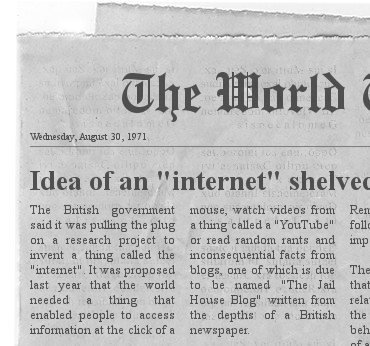
I recently stumbled a across a yellowed cutting that fell out from a cuttings file on the actress Pauline Collins. The article (pictured left) taken from the now defunked national newspaper "The World Today", suggests that the internet could have been invented by the British Government in 1971. Instead the money was diverted to save a small needle factory in Devon.
Or alternatively, I had too much time on my hands and created the cutting myself using this
Traying off-message
The undoubted success of New Labour's PR machine will warrant a fat chapter in media studies text books, long after Tony Blair leaves Downing Street. For those of us at the sharp end of spin culture it's easy to get a little jaded of politicians blurting out the party line. It's hardly surprising then, that news librarians, journalist and editors (in that order), long for well-drilled ministers to slip up or stray "off-message", some do it quite naturally, others are just unfortunate.
Pity then MP Caroline Flint's recent appearance on BBC's Newsnight. Tasked with having to defend the Government's relationship with troubled technology supplier ISoft, the Junior Health minister put in a performance Mr Tony would have been proud of.
Having survived a mauling by presenter Emily Matlis imagine Flint's horror then as she pressed play on the video later that evening. Although she maintained a fixed glare at the camera it was the tea lady in the office background who stole the show. Ghanaian born, Nana Amoatin , seemed unconcerned about such weighty matters as government bungling, choosing instead to carry out her tea duties, live broadcast or not. Admirable dedication you might think, but it was Mrs Amoatin's amazing techinque of carrying a full tray of mugs on her head that caught the eye of this librarian. Having passed on the sighting to the Guardian's diary columnist the item was published and sure enough a flurry of reader's emails lit up the editors inbox, eventually prompting the busy editor of BBC's Newsnight to pen an explanation for the programme's blog.
Pity then MP Caroline Flint's recent appearance on BBC's Newsnight. Tasked with having to defend the Government's relationship with troubled technology supplier ISoft, the Junior Health minister put in a performance Mr Tony would have been proud of.
Having survived a mauling by presenter Emily Matlis imagine Flint's horror then as she pressed play on the video later that evening. Although she maintained a fixed glare at the camera it was the tea lady in the office background who stole the show. Ghanaian born, Nana Amoatin , seemed unconcerned about such weighty matters as government bungling, choosing instead to carry out her tea duties, live broadcast or not. Admirable dedication you might think, but it was Mrs Amoatin's amazing techinque of carrying a full tray of mugs on her head that caught the eye of this librarian. Having passed on the sighting to the Guardian's diary columnist the item was published and sure enough a flurry of reader's emails lit up the editors inbox, eventually prompting the busy editor of BBC's Newsnight to pen an explanation for the programme's blog.
Tuesday, September 12, 2006
How to bribe the editors
Just spotted nytimes.com column Ask the Newsroom. It's been running for a few months, giving readers an insight into what goes on behind the scenes at a major daily. This week, assistant managing editor Richard L Berke describes the daily editorial meetings; apparently chocolate is the way to get your story on the front page. Maybe I should try that next time I write a sidebar.
A peek into the Guardian news conference is availbe daily from the Comment is Free website.
A peek into the Guardian news conference is availbe daily from the Comment is Free website.
Thursday, September 07, 2006
Google News Archive (again)
Over on ResourceShelf, Gary Price has some interesting things to
say about Google News Archive. Well worth a look.
say about Google News Archive. Well worth a look.
Wednesday, September 06, 2006
Google living in the past.
According to reports, Google is extending its news archive so that it goes back two hundred years! Having been a slave to expensive news databases such as Lexis Nexis for years I find it difficult to get much content going back earlier than the mid 90s (and that's the 1990s). One wonders how useful Google's freeNews Archive will actually be.
Tuesday, September 05, 2006
Shhhhhh!: comedy or tragedy?
News International's much anticipated freesheet thelondonpaper launched last night. I admit it was an impressive debut; its 'Love' section recounting readers' "dates from hell" and the love columnist with advice for those "back on the market" was especially enticing. However the scoop which will surely secure thelondonpaper's lead in the battle of the freesheets is the revelation that Scottish comedy genius Armando Iannucci has produced a new library based sitcom with Father Ted writer Arthur Mathews called 'Shhhhh!'. An original title for what Mathews describes as a ‘a stupid narrative comedy set in a municipal library’. One can only hope that the show shatters the negative stereotypes us information professionals regularly suffer but I suspect there will be at least one hilarious character with a tight bun and a mothballed cardie. The sitcom will star Morwenna Banks, Rebecca Front, and Simon Greenhall, who played Geordie Michael in I'm Alan Partridge and the pilot is being taped this month.
Monday, September 04, 2006
At the end of the day
"At the end of the day" was the most over-used cliche in British newspapers and websites between January and June 2006 , according to a new survey by Business news and information provider Factiva. There were 3,347 mentions, closely followed by "in the red" and "level playing field". The research found that financial turns of phrase were most popular, a pattern followed in most of the world's English speaking press. Biggest surprise though was the absence of "looks like a librarian" - must be a mistake. And if the survey was restricted to the library/ information management media, I'm sure that "thinking outside the box" would feature highly.
Here's an index of cliches with a slight US bias, where you can summon up a cliche quicker than shit goes through a goose.
Here's an index of cliches with a slight US bias, where you can summon up a cliche quicker than shit goes through a goose.
Thursday, August 31, 2006
Still alive in the morgues (2)
Fallout from the Fletcher article continues with a READER COMMENT in Cilip's Gazette. Sadly, not online but below is the text of the article, which appeared in the August 25 2006 edition.
READER COMMENT
News of our death is greatly exaggerated
Journalist Kim Fletcher writing in Media Guardian on 31 July welcomed the demise of the newspaper library and newspaper librarians. He was reacting to the news that the Daily Mail is to ditch both its cuttings library and the librarians working in it. ‘I suspect many journalists,’ he wrote, ‘who denounce the move will struggle to remember the last time they used the cuttings library’. His comment piece reads like the last time he saw the inside of newspaper library was when he went to see Michael Frayn’s play Alphabetical Order in 1975. Things have changed a lot since then.
The image of the librarian is constantly besmirched in the media. This week alone a pop singer was described as a ‘frumpish librarian’, a boring football commentator sounded ‘like a librarian’ and an actor was lampooned for having ‘all the lusty charisma of a librarian’. We have all grown used to these rigid stereotypes and they are nothing to get our brown cardigans in a twist over. What is harder to accept are myths about the work we do.
The view that media libraries exist just to provide a cuttings service is at least five years out-of-date. At the Guardian and Observer Library (now the Research and Information Department) the last hard copy newspaper clipping was safely filed away in 2001. Since then the role of the library and its librarians has vastly changed. As well as fielding enquiries from scores of journalists, librarians are responsible for writing factboxes, cvs and chronologies for publication, compiling primary research and assembling profile packages for features writers. The department is responsible for uploading the newspaper onto electronic databases – a cuttings service without the scissors. It also edits its own intranet, a much-used resource and trains journalists on how to use online sources.
Media librarians were glad to see the back of long days cutting up newspapers (and chasing journalists who’d walked off with files). The fact that journalists now have access to newspapers on their desktops hasn’t made us redundant. Our core skills are still in demand. We’re still archiving and retrieving information, shelving books and doing the odd bit of looseleaf filing. But we’re also doing things that were unheard of for a librarian a decade ago. Some media librarians have morphed into quasi-journalists, producing bylined copy and co-ordinating projects with journalists such as Freedom of Information requests.
Librarians have never feared the future. It was journalists who were desperately clinging on to the cumbersome cuttings file while the ‘disparate’ librarians (as Kim Fletcher describes them) were leading the electronic revolution.
Alan Power, Assistant Librarian/Researcher, Guardian and Observer Newspapers
READER COMMENT
News of our death is greatly exaggerated
Journalist Kim Fletcher writing in Media Guardian on 31 July welcomed the demise of the newspaper library and newspaper librarians. He was reacting to the news that the Daily Mail is to ditch both its cuttings library and the librarians working in it. ‘I suspect many journalists,’ he wrote, ‘who denounce the move will struggle to remember the last time they used the cuttings library’. His comment piece reads like the last time he saw the inside of newspaper library was when he went to see Michael Frayn’s play Alphabetical Order in 1975. Things have changed a lot since then.
The image of the librarian is constantly besmirched in the media. This week alone a pop singer was described as a ‘frumpish librarian’, a boring football commentator sounded ‘like a librarian’ and an actor was lampooned for having ‘all the lusty charisma of a librarian’. We have all grown used to these rigid stereotypes and they are nothing to get our brown cardigans in a twist over. What is harder to accept are myths about the work we do.
The view that media libraries exist just to provide a cuttings service is at least five years out-of-date. At the Guardian and Observer Library (now the Research and Information Department) the last hard copy newspaper clipping was safely filed away in 2001. Since then the role of the library and its librarians has vastly changed. As well as fielding enquiries from scores of journalists, librarians are responsible for writing factboxes, cvs and chronologies for publication, compiling primary research and assembling profile packages for features writers. The department is responsible for uploading the newspaper onto electronic databases – a cuttings service without the scissors. It also edits its own intranet, a much-used resource and trains journalists on how to use online sources.
Media librarians were glad to see the back of long days cutting up newspapers (and chasing journalists who’d walked off with files). The fact that journalists now have access to newspapers on their desktops hasn’t made us redundant. Our core skills are still in demand. We’re still archiving and retrieving information, shelving books and doing the odd bit of looseleaf filing. But we’re also doing things that were unheard of for a librarian a decade ago. Some media librarians have morphed into quasi-journalists, producing bylined copy and co-ordinating projects with journalists such as Freedom of Information requests.
Librarians have never feared the future. It was journalists who were desperately clinging on to the cumbersome cuttings file while the ‘disparate’ librarians (as Kim Fletcher describes them) were leading the electronic revolution.
Alan Power, Assistant Librarian/Researcher, Guardian and Observer Newspapers
Still alive in the morgues
Read Katharine Schopflin's great article in Cilip's UPDATE magazine on the past, present and future of media libraries here.
Thursday, August 24, 2006
Love Libraries?
Working in one every day it would be stretching it to say I love libraries but this campaign is trying to raise awareness of and improve public libraries.
"Love libraries is a campaign to get everyone excited about what public libraries can do for readers and how we can make them better!"
(That's their exclamation mark, not mine.)
"Love libraries is a campaign to get everyone excited about what public libraries can do for readers and how we can make them better!"
(That's their exclamation mark, not mine.)
Wednesday, August 23, 2006
Camping
OK, this isn't about media libraries although I did come across the story as I flicked my way through the London Evening Standard on the way to the Media page. Takeover speculation is looming over outdoor shops group Blacks Leisure today after it issued a second profit warning in a month. Apparently the lack of a Glastonbury festival this year has hit sales badly at its Millets chain.
Now I don't doubt that some festival goers buy their camping stuff at Millets but it sounds a bit lame to be blaming the non-appearance of a three-day event in a field for falling profits. It may be a fallow year at Worthy Farm, but there have been more festivals this year than ever before. It's like blaming a drop in the number of dinner jackets being hired on, say, the non-appearance of the Information Christmas party.
Now I don't doubt that some festival goers buy their camping stuff at Millets but it sounds a bit lame to be blaming the non-appearance of a three-day event in a field for falling profits. It may be a fallow year at Worthy Farm, but there have been more festivals this year than ever before. It's like blaming a drop in the number of dinner jackets being hired on, say, the non-appearance of the Information Christmas party.
What do librarians know about books, eh?
Nominations for the Quills, the book awards whose shortlist is drawn up by librarians and booksellers in the US, have been announced. Stephen King, for novel Cells, and Al Gore, for his eco-warrior tome The Inconvenient Truth, head the list.
Critics of the awards say they're too populist, sticking to the lowest common denominator bestseller lists rather than honouring works of literary genius (last year's inaugural overall winner was JK Rowling). But good writing is good writing and surely it's better to honour an author who can captivate many readers rather than one whose books may be well-written but are also unfathomable and unreadable? There's also a sinister overtone that librarians aren't capable of selecting deserving works, which is nonsense - or how did EL Doctorow's The March and David Mitchell's Black Swan Green (favourite to win this year's Booker prize) make the cut? Click here to vote.
Critics of the awards say they're too populist, sticking to the lowest common denominator bestseller lists rather than honouring works of literary genius (last year's inaugural overall winner was JK Rowling). But good writing is good writing and surely it's better to honour an author who can captivate many readers rather than one whose books may be well-written but are also unfathomable and unreadable? There's also a sinister overtone that librarians aren't capable of selecting deserving works, which is nonsense - or how did EL Doctorow's The March and David Mitchell's Black Swan Green (favourite to win this year's Booker prize) make the cut? Click here to vote.
Thursday, August 17, 2006
Dead or alive?
If you've ever wondered if that famous actor or singer is still kicking around, check out the Who's Alive and Who's Dead site. Of course it's easy enough to find out by doing the usual sort of searches, but may prove to be useful for more obscure characters. By the way, I found it on the excellent Phil Bradley blog. I also came across Populair, a page listing 100 different sites that keep up with what is new today, what people are taking about etc.
To google: no longer a verb
Google is trying to encourage people not to use the word Google as a verb in order to protect their brand, according to reports. Companies try to protect their brands by discouraging them from being used generically. So Google don't want you to say "I'll google that" when you mean "I'll search for that on the internet". But you are allowed to use it if you mean "I'll search for that using Google". It's a difficult job because dozens of brands have now lapsed because their use has become generic (eg: cashpoint and cellophane). An extensive list of generic and genericized trademarks courtesy of Wikipedia here.
Wednesday, August 16, 2006
Beyond the byline
There's a good explanation of what exactly news librarians do in this month's American Journalism Review. Well worth a look.
Casualty Count
As a news researcher it's often my job to do body counts. For example how many Israelis and Hezbollah have been killed in the recent conflict. And the next day it gets printed in the paper. One blogger has come up with the ultimate. Who has killed more? God or Satan? And the result is surprisingly surprising . . .
Monday, August 07, 2006
Newspaper librarians fight back
The backlash from Kim Fletcher's article in the Media Guardian has started. Katherine Schopflin won "letter of week" in Press Gazette and this reply appeared a week later on the MG letters page:
Guardian Media Pages
Fletcher must move out of Memory Lane
7 August 2006
The Guardian
Kim Fletcher claims he is "eager to avoid meandering down Memory Lane" - a quest made difficult by the fact that he probably lives there permanently. (Letting go of libraries is a sad necessity, July 31).The Guardian library (now the Research and Information Department) cut its last newspaper clipping in 2001 and switched to electronic databases for its archived-newspaper needs - a practice typical at most newspapers.
Since the change, media librarians have not been sitting around with idle scissors in hand, they have adapted and diversified to work within the new technological environment. A typical week in the Guardian Research and Information Department sees "librarians" handling research inquiries from scores of journals, factchecking for subs and desk editors, interrogating specialist databases, writing 300 word factboxes and phoning various organisations compiling primary research.
And how does he think newspapers make it on to an electronic database? That'll be the librarians who put it there. Finally it's worth remembering that when newspapers took the decision to ditch hardcopy cuttings and rely solely on electronic archives it was invariably the journalists who resisted moving forward with the times. Had the journalists got their way I would still be wrapped up in "the important business of filing".
Alan Power, Guardian Research & Information Department
Guardian Media Pages
Fletcher must move out of Memory Lane
7 August 2006
The Guardian
Kim Fletcher claims he is "eager to avoid meandering down Memory Lane" - a quest made difficult by the fact that he probably lives there permanently. (Letting go of libraries is a sad necessity, July 31).The Guardian library (now the Research and Information Department) cut its last newspaper clipping in 2001 and switched to electronic databases for its archived-newspaper needs - a practice typical at most newspapers.
Since the change, media librarians have not been sitting around with idle scissors in hand, they have adapted and diversified to work within the new technological environment. A typical week in the Guardian Research and Information Department sees "librarians" handling research inquiries from scores of journals, factchecking for subs and desk editors, interrogating specialist databases, writing 300 word factboxes and phoning various organisations compiling primary research.
And how does he think newspapers make it on to an electronic database? That'll be the librarians who put it there. Finally it's worth remembering that when newspapers took the decision to ditch hardcopy cuttings and rely solely on electronic archives it was invariably the journalists who resisted moving forward with the times. Had the journalists got their way I would still be wrapped up in "the important business of filing".
Alan Power, Guardian Research & Information Department
Thursday, August 03, 2006
Good riddance to the newspaper library?
Sad to see a column by Kim Fletcher in the Guardian welcoming the demise of the newspaper library. The writer's view of what a media library does and what media librarians do is at least five years out of date though. However, when he describes the librarians he's come across as "disparate", he may just have a point. Expect a backlash though. Librarians are a sensitive bunch.
Friday, July 21, 2006
Fight! Fight! Fight!
Googlefight compares the popularity of searches on Google. So for example, put BBC News and Guardian Unlimited up against other and see who wins.
Thursday, July 20, 2006
U R Hell
Here's a list of unfortunate urls that need a bit of re-thinking. They include:
Need a therapist? Try Therapist Finder at
www.therapistfinder.com
and
A site called ‘Who Represents‘ where you can find the name of the agent that represents a celebrity. Their domain name… wait for it… is
www.whorepresents.com
Need a therapist? Try Therapist Finder at
www.therapistfinder.com
and
A site called ‘Who Represents‘ where you can find the name of the agent that represents a celebrity. Their domain name… wait for it… is
www.whorepresents.com
Friday, July 14, 2006
Build your own search engine.
Thursday, July 13, 2006
How to become a librarian.
The Times have produced a short article on how to become a librarian. It will be news to some journalists and lawyers that I've worked for that not only do you have to "have a degree to be a librarian!?!?" you also need a masters as well(?!!!).
Tuesday, July 11, 2006
Are you reading the news?
Apparently news stories on the web are barely read by anyone 36 hours after they were posted. That's the message from a team of statistical physicists at the University of Notre Dame in the US and colleagues in Hungary who have analysed how people access information online. The short life of a news item implies that people could miss significant news by not visiting the site when a new document is first displayed, which is a good reason for publishers providing e-mail news alerts. The full story on physicsweb.
Wednesday, July 05, 2006
Washington Post News Research Center
Deborah Howell, The Washington Post's Ombudsman, has written a great column on the Washington Post News Research Center. I don't thnk you could better the quote (from the Center director) that research staff are "news junkies, who see themselves not just as librarians but journalists finding and analyzing original documents, tracking people down, finding leads, using obscure databases."
Thursday, June 29, 2006
man bites dog
Looking for reviews of film Shoot the Messenger I came across a lovely headline from the LA Times: Top cop tried to shoot messenger (June 25, 2006). Sadly the online headline is less interesting but here's the story. If you think you can do better check out Man Bites Dog, for budding Sun reporters everywhere.
Wednesday, June 14, 2006
Vive, vive, Cote d'Ivoire!
To highlight global poverty during the World Cup, the World Development Movement has come up with Who Should I Cheer For?, a handy guide to which countries are most supportable in terms of, among other factors, poverty, aid, military spending and human rights. The site also lists separate rankings for each category. Statistics are sourced from the
UN Development Report, OECD, World Bank, Transparency International and the FT, so it's a great shortcut for those niggly country comparison questions. Ghana to win!
UN Development Report, OECD, World Bank, Transparency International and the FT, so it's a great shortcut for those niggly country comparison questions. Ghana to win!
The Guardian is, like, sooo gay
Last week the BBC complaints committee ruled in favour of Chris Moyles, deciding that the word gay was acceptable yoof speak for "lame or rubbish" (Evening Standard). It seems unfortunate then that Stuart Jeffries of the Guardian should choose to describe the Canadian marriage of Sue Wilkinson and Celia Kitzinger as "gay in every sense of the word". Or is the paper not as liberal as it makes out?
Friday, May 26, 2006
The Diana Express
Scanning the tabloids recently it struck me that the Express seems to know something the rest of us don't about the death of Princess Diana. I conducted a vaguely scientific experiment to see how often the Express carried stories on the People's Princess. Over a period of five weeks, it gave six front pages to Diana, and mentioned her in 36 separate articles (aside from front page stories on the Queen's 80th birthday, Princess Michael's indiscretions and Camilla's unsuitability as Diana's replacement). Charles must be jubilant.
Here's how the other big nationals fared:
Times/Sunday Times: 7 mentions
Telegraph/Sunday Telegraph: 3
Independent/Independent on Sunday: 5
Guardian/Observer: 15
Daily Mail/Mail on Sunday: 31
Mirror/Sunday Mirror: 14
Sun/News of the World: 20
The Guardian's G2 beat me to this story, but I'm not bitter, oh no...
Here's how the other big nationals fared:
Times/Sunday Times: 7 mentions
Telegraph/Sunday Telegraph: 3
Independent/Independent on Sunday: 5
Guardian/Observer: 15
Daily Mail/Mail on Sunday: 31
Mirror/Sunday Mirror: 14
Sun/News of the World: 20
The Guardian's G2 beat me to this story, but I'm not bitter, oh no...
Wednesday, May 10, 2006
Hosting the front page.
The British Library is hosting an exhibition of memorable front pages from the past 100 years, to celebrate the centenary of the Newspaper Publishers Association. No doubt some poor librarian had to go scrabbling through the cuttings files to find them. Newsnight is running a poll to find the best one - three of the top ten are from the Sun, but then tabloids always have more dramatic front pages, so this is probably reflected in the exhibition (especially as I hear Associated Newspapers had a veto on what went into the exhibition). If "Freddie Starr ate my hamster" wins it'll be a sad day for journalism. Exhibition opens May 25.
Thursday, May 04, 2006
Free Maps at the Indy
I really like the Indy's recent set of free maps. The US map is full of statistics no doubt compiled by a harrassed researcher. The only disappointment is the breakdown in ethnic groups - I can only assume that America's hispanic population of 40 million has been lumped in to the 'white' sector, which makes up 75.6%, according to the chart. I can't imagine the immigrants who have been protesting this week would be happy to be ignored by the British press as well as the White House. For more detailed population figures, see the US Census Bureau.
F****** Blogs!!!
This week's Press Gazette features comments from Observer editor, Roger Alton. On blogs, he suggests that blogs will never replace newspapers. He says, "Blogs are basically comment on stories that have been broken by other media most of the time."
I'm not even going to comment on that.
I'm not even going to comment on that.
Ha Ha Headlines
There's an email doing the rounds detailing the most bizarre headlines from newspapers in 2005. Like the good little researchers we are we ran a few checks and some actually date back to 1990. Even so they are still a bit of a larf:
Crack Found on Governor's Daughter
Something Went Wrong in Jet Crash, Expert Says
Police Begin Campaign to Run Down Jaywalkers
Panda Mating Fails; Veterinarian Takes Over
Miners Refuse to Work after Death
Juvenile Court to Try Shooting Defendant
War Dims Hope for Peace
If Strike Isn't Settled Quickly, It May Last Awhile
Cold Wave Linked to Temperatures
Enfield (London) Couple Slain; Police Suspect Homicide
Red Tape Holds Up New Bridges
Man Struck By Lightning: Faces Battery Charge
New Study of Obesity Looks for Larger Test Group
Astronaut Takes Blame for Gas In Spacecraft
Kids Make Nutritious Snacks
Local High School Dropouts Cut in Half
Hospitals are Sued by 7 Foot Doctors
And the winner is....
Typhoon Rips Through Cemetery; Hundreds Dead
Crack Found on Governor's Daughter
Something Went Wrong in Jet Crash, Expert Says
Police Begin Campaign to Run Down Jaywalkers
Panda Mating Fails; Veterinarian Takes Over
Miners Refuse to Work after Death
Juvenile Court to Try Shooting Defendant
War Dims Hope for Peace
If Strike Isn't Settled Quickly, It May Last Awhile
Cold Wave Linked to Temperatures
Enfield (London) Couple Slain; Police Suspect Homicide
Red Tape Holds Up New Bridges
Man Struck By Lightning: Faces Battery Charge
New Study of Obesity Looks for Larger Test Group
Astronaut Takes Blame for Gas In Spacecraft
Kids Make Nutritious Snacks
Local High School Dropouts Cut in Half
Hospitals are Sued by 7 Foot Doctors
And the winner is....
Typhoon Rips Through Cemetery; Hundreds Dead
Friday, April 28, 2006
Enquiry of the week
Can you find me an academic paper on the rise of women taxi drivers reportedly being asked for sex by their male customers?
Thursday, April 27, 2006
Shoot the text messengers.
Read here why shooting library users who use mobile phones in the library is a good thing.
Wednesday, April 26, 2006
Librarians forever!!
The lastest issue of AUKML's newsletter, Deadline (sadly not online yet), includes an excellent explanation of why information professionals are still far better than Google. Omer Ali, Time Out's listings editor, is obviously a fan of the librarian, and this quote deserves to be repeated in dissertations across the land.
"It would be a very sad indication of our arrogance and the decline in our estimation of knowledge if we thought that the superficial research the internet affords can in any way beat a well-trained librarian."
For those of you from foreign climes, AUKML is the Association of UK Media Librarians, and here'stheir site - well worth a look.
"It would be a very sad indication of our arrogance and the decline in our estimation of knowledge if we thought that the superficial research the internet affords can in any way beat a well-trained librarian."
For those of you from foreign climes, AUKML is the Association of UK Media Librarians, and here'stheir site - well worth a look.
Tuesday, April 25, 2006
Loss of Mirror library
The Daily Mirror no longer has a library. Or rather, as reported in the Press Gazette's Axegrinder column, it does but from now on all cuttings are compiled electronically by cheap labour in Delhi. I'm sure they're doing a fine job although there are worrying stories about the Horse Racing cuts becoming' 'Orse Racing' and, er, the 'S' being missed off Scunthorpe. Of course this could be sabotage but I suspect the mistakes are real...
Monday, April 24, 2006
Can't see the map for the trees.
I'm not sure why, but a journalist who is lost in a park phones up the department and asks us to locate a certain tree for her. Needless to say the web isn't crawling with park maps that identify every tree contained therein.
And talking of trees: I found this tale of woe on a favourite blog of mine, newsarama. The writer's house had been damaged in a tornado. It encapsulates the attitude of some of my esteemed colleagues rather well.
The reporter showed up with a cameraman and I began to explain how the Insurance Company had ignored my little baby son, how his health had been jeopardized, how we had been misled intentionally on five or six separate occasions.
The reporter lady looked genuinely dismayed: “I thought the tree was still stuck in the back of your house,” she said.
“No, it slid down to the ground. The story is about the Insurance Company. I have a little premature baby with underdeveloped lungs and there is a huge hole in the roof. There’s fiberglass insulation everywhere. They keep ignoring us.”
The Television reporter looked pained. “We can’t do that story,” she said. “They advertise with us.”
And talking of trees: I found this tale of woe on a favourite blog of mine, newsarama. The writer's house had been damaged in a tornado. It encapsulates the attitude of some of my esteemed colleagues rather well.
The reporter showed up with a cameraman and I began to explain how the Insurance Company had ignored my little baby son, how his health had been jeopardized, how we had been misled intentionally on five or six separate occasions.
The reporter lady looked genuinely dismayed: “I thought the tree was still stuck in the back of your house,” she said.
“No, it slid down to the ground. The story is about the Insurance Company. I have a little premature baby with underdeveloped lungs and there is a huge hole in the roof. There’s fiberglass insulation everywhere. They keep ignoring us.”
The Television reporter looked pained. “We can’t do that story,” she said. “They advertise with us.”
Thursday, April 20, 2006
The seldom visited fourth page.
An survey by iProspect has found what most internet users already suspect - that most people only bother to look at the first few results of a web search. It found that 62% of search engine users click on a site on the first page of results, with 90% clicking on a site within the first three pages (up from 48% & 81% in 2002).
This confirms either:
a) Search engines are amazing at doing their job
b) Searchers are amazing at doing their job
c) Searchers are lazy
I suspect that c) is the correct answer. And hope that professional searchers are digging deeper into the results pages . . .
This confirms either:
a) Search engines are amazing at doing their job
b) Searchers are amazing at doing their job
c) Searchers are lazy
I suspect that c) is the correct answer. And hope that professional searchers are digging deeper into the results pages . . .
Wednesday, April 19, 2006
What's the point?
A recent poll by British Market Research Bureau found that the proportion of internet users in Britain who have never heard of a blog, or blogging, fell from 45% to 30% over the last three months. It also found that just 2% of UK internet users publish blogs with only 10% - around 2.8 million people - of internet users view a weblog once a month or more.
With such a low audience, I don't know why I even bother.
With such a low audience, I don't know why I even bother.
Friday, April 07, 2006
Ignore it and it might just go away.
We've all done it, that's right at some point we've spotted a bit of librarian bashing in the national media then almost tripped over our corduroy pants, so eager are we to stick the offending cutting on departmental noticeboards or broadcast it to next to no one on blog sites. Librarians have always been an easy target for the media, too easy some might say.
Back in 1995 I remember telling someone I had successfully landed a job in an academic library, she told me about her friend who appaered on a Richard and Judy makeover for Librarians. When the feature went live Judy was muscled out of shot as Richard with his well trained sartorial eye delivered a pronouncement on the inevitable transformation, it was that good. I later found out the "girls from Manchester Libraries" were told to ditch what they wore to the studio that day and instead rummage through a box of tatty clothes which they had to wear for the broadcast. The point being it would make good T.V. Another friend applied for Channel 4's Faking It only to be rejected for not fitting the stereotype.
Faced with such cynicism by those running the media, how are we as ninja like trained assasins in librarianship suppossed to react?.
I suggest not retaliating with nunchucks or throwing stars but, maybe simply ignoring it?...how absurd you might think, but surely flagging up such stories (like I'm doing here) we only draw attention to the issue and make the 'cool' people who shape the news agenda think we really are insecure about our image.
Back in 1995 I remember telling someone I had successfully landed a job in an academic library, she told me about her friend who appaered on a Richard and Judy makeover for Librarians. When the feature went live Judy was muscled out of shot as Richard with his well trained sartorial eye delivered a pronouncement on the inevitable transformation, it was that good. I later found out the "girls from Manchester Libraries" were told to ditch what they wore to the studio that day and instead rummage through a box of tatty clothes which they had to wear for the broadcast. The point being it would make good T.V. Another friend applied for Channel 4's Faking It only to be rejected for not fitting the stereotype.
Faced with such cynicism by those running the media, how are we as ninja like trained assasins in librarianship suppossed to react?.
I suggest not retaliating with nunchucks or throwing stars but, maybe simply ignoring it?...how absurd you might think, but surely flagging up such stories (like I'm doing here) we only draw attention to the issue and make the 'cool' people who shape the news agenda think we really are insecure about our image.
Monday, April 03, 2006
Dave's new friend
The Guardian's April Fools about Coldplay's Chris Martin joining the Tories and writing a song for them made for very jolly reading on Saturday morning. Even better though was the news in the Observer that the Labour Party's media monitoring unit fell for the tale and distributed it to most of the government. Maybe they we seduced into thinking it was the real thing by the impeccably researched (and genuine) box of facts that accompanied the story. Listen to the song here
Subscribe to:
Comments (Atom)